
King George Wasn’t Mad. That’s the Whole Problem.
Part of The Language of Power · Chapter 3 of 4 →Twelve Lines in the Key of a King Who Was Never Actually Crazy
Let’s open with a song that doesn’t exist.
I wrote this. It is not from anything. It is a pastiche, which is a fancy word for theft with the serial numbers filed off, and I’m filing them in public so nobody writes me a letter. Rhyme scheme is AAAA BB CCCC AA, which is the shape Lin-Manuel Miranda likes when a character is about to tell you the truth while pretending to be charming.
Read it out loud. You won’t, but you should, and your dog will respect you more.
Observe me. I am lucid. I am temperate. I’m sane.
I have not lost my reason, I have only lost terrain.
A continent, a harbor, and a tax I can’t maintain,
And suddenly there’s whispering in Commons ’bout my brain.
So in they marched, the doctors, with a candle and a claim,
And left me with a diagnosis bolted to my name.
But here’s the part they leave out of the pretty little books:
I never raved. I governed. With my ministers and crooks.
I signed. I taxed. I garrisoned. I never once mistook
A policy for weather, though that’s all the record took.
So let them call me mad. It’s the most flattering refrain:
The mad king is forgiven. And forgiven, I remain.
There. That’s the thesis, sung by the defendant.
Now let me spend four thousand words proving he’s right, which is an unusual position for me and I’m as surprised as you are.
The Man Who Spat on Broadway for Three Years
First, the fun part.
Jonathan Groff played King George III in Hamilton, which is a role with a strange shape: three short songs, maybe nine minutes of stage time across a two-and-a-half-hour show, and he steals the entire thing anyway. He got a Tony nomination out of nine minutes. That’s a batting average.
And what made the performance land, apart from the thing everyone noticed, which is that the man produces saliva at a rate that should concern a physician, is that Groff’s King George is not crazy.
Watch it again. He’s petulant, he’s possessive, he’s enormously pleased with himself, and he is absolutely, pin-sharp LUCID. The joke of the character is not that he’s lost his mind. The joke is that he hasn’t. He’s a jilted boyfriend with a navy. He sings what sounds like a love song and it is, structurally, a threat, and the reason it’s funny is that from INSIDE his premise it’s all perfectly reasonable. He thinks he owns you. He is baffled and hurt that you disagree. Everything downstream of that is sane.
Miranda could have written him raving. The historical license was sitting right there, pre-approved by two hundred years of popular history and an Oscar-winning film with the word MADNESS in the title.
He didn’t take it. And I’ve come to think that’s the most intelligent single choice in the show.
STOP.
Full turn signal, because we are going to leave the theater now and we are not coming back. What follows is a history of a diagnosis, three case files, and then this week in America. I’d rather you saw the turn coming, because it gets less funny as we go.
About That Madness
Here’s what most people know: George III went mad, it was probably porphyria, there’s a play and a film about it, and it explains why Britain lost America.
Here’s what’s actually true.
The porphyria theory was proposed in 1964 by two psychiatrists, Ida Macalpine and Richard Hunter. It was elegant, it was tidy, and it had a wonderful feature: it meant the King was never mentally ill at all, just physically sick with something that produces psychiatric symptoms. A metabolic alibi. The theory took off, got absorbed into popular history, and then a play and a film poured concrete over it.
It has since been taken apart, in public, by people who do this for a living. The British Journal of Psychiatry carried the re-evaluation. The objections are not vibes:
- Porphyria attacks are typically triggered by medications that did not exist in his lifetime.
- He did not have the persistent severe abdominal pain that variegate porphyria produces.
- He had none of the characteristic photosensitive skin lesions.
- Psychiatric symptoms appear in under 1% of acute attacks.
- And the killer: roughly 180 living descendants would be expected to carry the disorder. Not one has been reported.
The current reading, supported by structured diagnostic analysis of the contemporary records, is acute mania, with his October 1788 episode scoring a severe 4 out of 4 on the Young Mania Rating Scale, with probable hypomania before it and low mood between episodes. Which is to say: a real and serious illness, in a real man, who suffered, and whose doctors, incidentally, were not the sadists the porphyria story painted them as.
But that’s not the line that got me.
The line that got me is the author’s argument that the porphyria narrative obscured the historical explanations of George’s behavior. His persistence with failing policies. His strained relationships with his children. His repeated offers to abdicate during periods of stress.
Read that again.
The diagnosis didn’t just get the medicine wrong. It got in the way of the HISTORY. For sixty years, a wrong answer about his blood chemistry stood in for every question anybody might have asked about his judgment.
Madness Is the Most Comfortable Thing You Can Say About a King
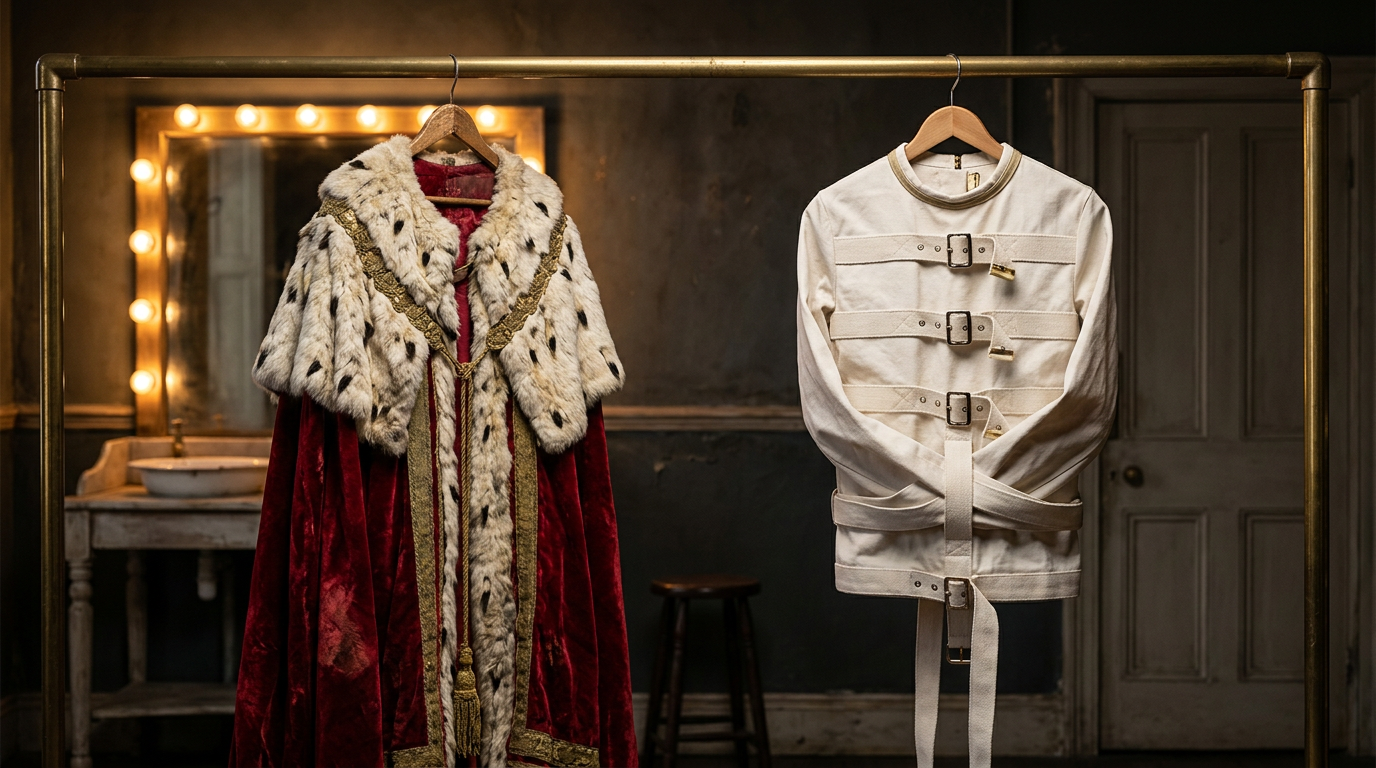
Here’s the pattern, and I want to lay out the case files because one example is an anecdote and three is a mechanism.
File one: the horse.
You know this one. Caligula made his horse a consul. It is the single most famous piece of imperial lunacy in the Western canon, deployed in a thousand op-eds about a thousand different governments.
It didn’t happen.
Go to the sources. Suetonius, writing around 121 AD, roughly eighty years after the fact, says Caligula planned to make Incitatus a consul. Cassius Dio, writing a century after THAT, says the plans were never carried out. Both writers describe the marble stable, the ivory manger, the jeweled collar. Neither says it happened, because it didn’t.
And the modern reading is better than the myth. The historian Anthony Barrett argues these accounts were shaped by the politics of the men writing them, that trashing the early emperors was useful to later ones, and that the lurid version sold scrolls. The prevailing scholarly interpretation of the horse is that it was a joke. An elaborate, hostile, deliberately humiliating joke, aimed directly at the Senate, whose content was: a horse could do your job.
That’s not insanity. That’s contempt, expressed with theatrical precision. And the Senate understood it perfectly, which is exactly why it stung, and exactly why their partisans spent the next two centuries recording it as proof he’d lost his mind.
File two: the queen.
Juana of Castile. Daughter of Ferdinand and Isabella, mother of an emperor, legal queen of Castile and later Aragon, and known for five hundred years as Juana la Loca. Juana the Mad.
She spent most of her adult life confined at Tordesillas. Was she ill? Quite possibly. The historical record is genuinely contested and serious historians land in different places, so I’m not going to pretend to settle it from a desk in Buenos Aires.
Here’s what isn’t contested. The two people who declared her unfit, and who governed in her name while she was shut away, were her father and then her son. Both of whom got a kingdom out of the arrangement.
I’m not freaking Hilary Mantel. But when a diagnosis is issued by the party that inherits the estate, a normal person is allowed to raise an eyebrow.
File three: the calendar.
Now the modern one, and it connects to something I wrote yesterday, which I did not plan and which gave me a genuinely unpleasant feeling when I noticed it.
Saparmurat Niyazov, president-for-life of Turkmenistan. In August 2002 his government passed a law renaming every month of the year and nearly every day of the week.
January became Türkmenbaşy, which was his own adopted title. It means Leader of the Turkmen.
April became Gurbansoltan. That was his mother’s name.
September became Ruhnama, after the book he wrote.
The Western press ran this for a decade as the definitive example of a dictator who had gone completely around the bend. Look at the madman. He renamed April after his mum.
He wasn’t mad. He was BRANDING. It is the single most efficient act of state propaganda available to a small country with a large ego, because it embeds you in a sentence every citizen is forced to say out loud twelve times a year, for free, forever. Every appointment, every invoice, every birthday card. You cannot make a dentist’s appointment without saying the leader’s name.
It worked until he died in 2006. The old names came back in July 2008, about eighteen months after he stopped being able to enforce them. Which tells you exactly how deep it went and exactly how calculated it was.
And yesterday I wrote two thousand words about an executive order renaming artificial intelligence across the United States federal government, and I did not once think of Turkmenistan, and that is my failure, not yours.
So. This Week.
Right. Let’s do the thing we’re here for, and let’s do it with the quotes in front of us, because I am not going to be the guy who builds an argument on a paraphrase.
Monday, October 5. Grand Island, Nebraska. Pinnacle Bank Expo Center. The President, at a rally, discussing the Iran war and gas prices and whether the pain is worth it:
“They can take out a city. Let them take, let it — let them take out Los Angeles.”
“Let them take out San Diego. That’s — this is a very small price to pay, and it’s gonna be over very soon.”
The White House says he was misunderstood. Communications Director Steven Cheung said the point was that American cities would have been threatened if a nuclear Iran hadn’t been stopped, and I want that on the record in my own post because it’s their explanation and you’re entitled to it. Some analysts agreed the wording was convoluted enough to obscure the intent. Others read the plain text.
The reaction from the people who represent those cities did not split.
Gavin Newsom called him “deranged and dangerous.” San Diego Mayor Todd Gloria wrote that San Diego “is not collateral damage.” LA Mayor Karen Bass said a president’s job is to protect the country, not threaten it. Rep. Scott Peters, who represents San Diego, pointed out the thing that should have ended the conversation: roughly 115,000 active-duty servicemembers and their families live in that city.
Friday and Saturday, October 9 and 10. The Nobel Peace Prize goes to Navi Pillay. The President’s response, per the reporting, is that the committee’s decision leaves an “indelible stain” on Norway. Axios used the word “rages.” CNN’s framing was that the quest for the prize has become the butt of the joke.
Sunday, October 4, for context, on social media: “Voting in America is CORRUPT!!!” Three exclamation marks, and I counted them twice because I wanted to be fair.
And on the midterms, the actual record, which is more precise than the version going around and worse for it. Asked by NBC’s Tom Llamas whether he’d respect the results, he said he would “if the elections are honest.” And if they aren’t, “then something else has to happen.”
Not unless I win. That version is floating around and it’s wrong, and the real one is colder: he will accept the result if he judges it honest. The standard exists. He holds it. He did not say what it is.
Congressman Jim Himes, ranking Democrat on House Intelligence, put it at a briefing in Stamford on October 7 about as plainly as it can be put: “the president has never accepted the results of an election that he didn’t like.”
Now the Part Where I Refuse to Give You What You Came For
Here’s where this post turns into a different post, and some of you are going to be annoyed, and I’d rather annoy you than lie to you.
Every single person reading the section above has a word ready. The word is some version of unhinged, deranged, demented, losing it, not well, not all there. It’s right at the front of the mouth. Newsom used a version of it on the record.
I’m not going to use it. Not because I’m being delicate, and not because I think he’s fine. Because it’s the weakest available explanation and it does his work for him.
Run it through the case files.
Madness explains nothing. That’s its function. It is a terminal node. Once you’ve said he’s crazy, there is no next question, which is why it’s the most popular thing to say and the least useful. It is the historical equivalent of a shrug with a vocabulary.
Madness is almost always wrong. George: wrong diagnosis for sixty years, and the wrong diagnosis blocked the real inquiry. Caligula: never happened, and the thing that did happen was a calculated insult. Juana: declared by her heirs. Niyazov: a marketing campaign that everyone filed as lunacy for a decade.
Madness is useful, and the question is always to whom. Sometimes to the enemies of the ruler, who’d rather you think he’s broken than that he’s effective. Sometimes to the ruler himself, because a man who isn’t in his right mind did not DECIDE anything, and a man who didn’t decide anything cannot be held to have chosen it. That’s not a loophole. That’s the whole legal theory of the thing.
And here’s what happens when you accept it. If he’s mad, then the officials who carry it out are managing an illness rather than executing a policy. The people who applauded in Nebraska were watching a symptom, not agreeing with a sentence. The lawyers who draft it are nurses. Nobody chose anything. Nobody signed anything. It’s weather.
It is not weather. The Nebraska remark was made in a prepared setting, to a crowd, on camera, as part of an argument about why the current pain is worth it. The Nobel response was a statement about a foreign government. The DOJ terminology memo I wrote about on Sunday has an author, a date, and a distribution list. Those are documents and events with names attached. They were produced by an apparatus that functioned exactly as designed.
Go back to Groff. Nine minutes, three songs, a Tony nomination, and a character who is never once written as crazy. Miranda understood something that two centuries of popular history missed: a king who has lost his mind is a tragedy, and a king who is in full possession of it is a problem. One of those you manage. The other one you have to actually do something about.
The Counterargument, Properly Made
Four, and I’m not going to strawman any of them.
One. Sometimes leaders really are ill, and the taboo on saying so has costs. Woodrow Wilson had a stroke in office and his wife and doctor concealed the extent of it. That was a genuine constitutional emergency handled by nobody. “Never discuss a leader’s health” is not a rule I actually want, and anybody who’s watched a parent decline knows that polite silence is its own kind of damage.
Two. The Goldwater rule exists for a reason, and it cuts both ways. Psychiatrists don’t diagnose public figures they haven’t examined, after a 1964 magazine poll in which over a thousand of them declared a presidential candidate unfit. The reason that rule exists is that it was abused, and it was abused in a presidential campaign, and it will be abused again, in whichever direction is convenient. The people most confident about a diagnosis are rarely the people qualified to make one.
Three. “He’s not crazy, he means it” is also a rhetorical move. It sounds more rigorous. It can also be a way of attributing cold strategy to behavior that’s just chaotic, which flatters the subject by making him an operator. Some things are sloppy. Some rally remarks are a tired man in hour two of a speech that got away from him, which is the White House’s position here and it is not an insane position.
Four. I’m a guy with a blog in Buenos Aires. I read the same transcripts you can read. I have no access, no sources and no standing, and if your epistemics depend on me you have bigger problems than this post.
Hold all four. Then hold this.
Nothing in that list requires the madness frame. You can say “I don’t know his medical condition, it’s not my business, and it does not matter” and still read a transcript. The transcript is the transcript. The vote on the appropriation is the vote on the appropriation. The memo has a signature block.
What George Actually Said
One last thing, and it’s the reason I started writing this at six in the morning instead of sleeping.
George III, in his lucid decades, was by most accounts a conscientious man. Diligent. Interested in agriculture to the point of boring people about turnips at dinner. He thought he was doing right by an empire he had inherited and believed in, and he persisted with failing policies long past the point where persistence was a virtue, and the reason he did that was NOT illness, because the illness came later.
He did it because he believed he was correct and because the structures around him did not stop him.
That is the actual story. It’s less dramatic than a mad king howling at Windsor and it is the only version with a lesson in it, because the mad king is a freak event and the stubborn king surrounded by people who won’t say no is a recurring condition of government in every era, on every continent, right now, including probably wherever you work.
The British Journal of Psychiatry spent a paper arguing that a wrong diagnosis obscured the historical explanation.
Two and a half centuries later we are still doing it, and we’re doing it faster, and we’re doing it on our phones, and every time somebody says the word unhinged a very slight pressure comes off a decision that a person made on purpose, in a building, on a Monday, in Nebraska.
Observe him. He is lucid.
That’s not the comforting read. That’s just the one that survives contact with the sources.
Quick Questions From the Cheap Seats
Was King George III actually mad?
He experienced at least one severe psychiatric episode, with the first major one in 1788, twenty-eight years into his reign. The long-popular theory that this was porphyria, proposed in 1964 by Ida Macalpine and Richard Hunter, has been substantially dismantled: the attacks lack porphyria’s typical triggers, pain pattern and skin lesions, psychiatric symptoms occur in under 1% of acute attacks, and none of roughly 180 living descendants has been reported with the disorder. The current leading interpretation is acute mania, with his October 1788 episode rated severe on the Young Mania Rating Scale.
Did Caligula really make his horse a consul?
No. Suetonius wrote that Caligula planned to make Incitatus a consul, and Cassius Dio states the plan was never carried out. Both wrote decades or centuries after the fact. Modern historians including Anthony Barrett read the episode as an elaborate insult aimed at the Senate, with the implied message that a horse could do a senator’s job, and note that the surviving sources were written under later regimes that benefited from discrediting the Julio-Claudians.
Why is Juana of Castile called “la Loca”?
Joanna of Castile was declared unfit to rule and confined at Tordesillas for most of her adult life. Historians disagree about whether and how far she was mentally ill. What is not disputed is that the two people who governed in her name during her confinement were her father, Ferdinand of Aragon, and then her son, Charles V, both of whom gained authority from the arrangement.
Did a dictator really rename the months of the year?
Yes. On 10 August 2002, Turkmenistan under Saparmurat Niyazov renamed all twelve months and most days of the week. January became Türkmenbaşy, Niyazov’s own adopted title; April became Gurbansoltan, his mother’s name; September became Ruhnama, after the book he wrote. Niyazov died in 2006 and the original names were restored in July 2008.
Is Hamilton’s King George portrayed as insane?
No. Jonathan Groff’s King George III appears in three short songs totaling around nine minutes of stage time and earned him a Tony nomination. The character is written as lucid, possessive and self-assured rather than deranged, and the comedy comes from how reasonable his menace sounds from inside his own assumptions about ownership of the colonies.
What did Trump say about Iran, Los Angeles and San Diego?
At a rally in Grand Island, Nebraska on October 5, 2026, discussing the Iran war and economic costs, he said: “They can take out a city. Let them take, let it — let them take out Los Angeles,” and “Let them take out San Diego. That’s — this is a very small price to pay, and it’s gonna be over very soon.” The White House said he was misunderstood and meant that US cities would have been at risk had a nuclear Iran not been confronted. California Governor Gavin Newsom, San Diego Mayor Todd Gloria, Los Angeles Mayor Karen Bass and Rep. Scott Peters all publicly objected.
Rant over. No doctors were consulted in the writing of this, which is the point.
Somewhere there’s a crown on a cushion with wires coming out of it, and a very expensive machine at the other end, printing a long strip of paper that nobody is going to read, because everybody in the room already decided what it says.