The DOJ Can No Longer Say “Artificial Intelligence”
Part of The AI Files · Chapter 4 of 5 → Part of The Language of Power · Chapter 2 of 4 →They Renamed the Apocalypse and It Came Back Sounding Like a Breakfast Cereal
There is a specific claptrap bugle blast a government makes when it has decided to do something about a problem without doing anything about the problem. Which is basically window dressing with panache.
It’s a dry noise. Papery. Somewhere between a stapler and a man clearing his throat before he says the word “optics.”
On September 29, 2026, the President of the United States signed Executive Order 14434, and the noise it made could be heard in three time zones.
The order renames artificial intelligence.
That’s it. That’s what it does. Across the executive branch of the United States government, “artificial intelligence” and “AI” are out. The approved terms, going forward, in correspondence, public communications, websites, reports and policy documents, are “Super Intelligence” and “SI.”
To the maximum extent permitted by law. Which is a phrase I want you to hold onto, because we’ll be coming back for it with a flashlight.
And then on October 6, Acting Deputy Attorney General Trent McCotter sent the memo making it Justice Department house style. Public statements. Policy documents. Records. Communications. And, where appropriate, court filings.
Somewhere in America there is now a federal prosecutor standing in front of a judge, under oath, in a building with a flag in it, saying the words “super intelligence” about a piece of software that recommends sentencing guidelines, and the judge has to keep a straight face, and so does the stenographer, and so do I, and I’m failing.
Sit down. Yes, you. You came here voluntarily and now you’re in it with me.
STOP.
Full turn signal, because this post goes somewhere you won’t expect from the opening. We are going to laugh at this for about nine hundred words. Then we’re going to stop laughing, because buried in the same document is a sixty-day clock that nobody quoted, and it runs out in late November. I’d rather you saw the turn coming.
Every Euphemism Runs Downhill. This One Went Up.
Here is the thing that made me put down my coffee.
Political language has ONE direction. One. It goes toward the softer word, every time, without exception, in every government that has ever existed, and it does it for the same reason water goes downhill.
Follow the bouncing ball.
A soldier comes back from the Somme shaking and unable to speak and in 1917 we call it shell shock, which is two hard syllables that sound like what they describe. By the Second World War it’s battle fatigue, which sounds like he needs a nap. Korea gives us operational exhaustion, which sounds like a logistics problem. And by 1980 it’s post-traumatic stress disorder, eight syllables, four of them clinical, and George Carlin’s point about all this was that somewhere in that sentence the pain got pressure-washed off.
Torture becomes “enhanced interrogation.”
Civilian deaths become “collateral damage.”
Firing people becomes “rightsizing,” which is a word that somebody got paid to invent, and I hope he’s happy, and I hope his heating bill is enormous.
And in 2002, the Republican messaging strategist Frank Luntz told his clients to stop saying “global warming” and start saying “climate change,” and he did not even dress up his reasoning. He said in writing that the second one sounds like “a more controllable and less emotional challenge.”
That’s the mechanism, stated out loud by a professional. The word moves so the argument doesn’t have to. You don’t win the fight. You rename the ring.
Now look at what just happened.
They went the OTHER WAY. They took a technology that two thirds of the country already thinks is moving too fast, and they renamed it to something that sounds like it has heat vision.
You see the problem. Everybody is already nervous, and the official response was to give the thing a name that sounds like the final boss.
Which is backwards, which is impossible, which means I had it wrong.
I Had It Wrong, and the Reason Is Breakfast
Here’s where I turned the thing over and saw the bottom of it.
“Super” is not a scary word in American English. It has never once been a scary word in American English. It is possibly the least scary morpheme in the whole language.
Super Bowl. Supermarket. Super-size. Superman. Super Glue. Super Mario. Supertramp, God help us. Your aunt describing a casserole. A referee describing a Tuesday.
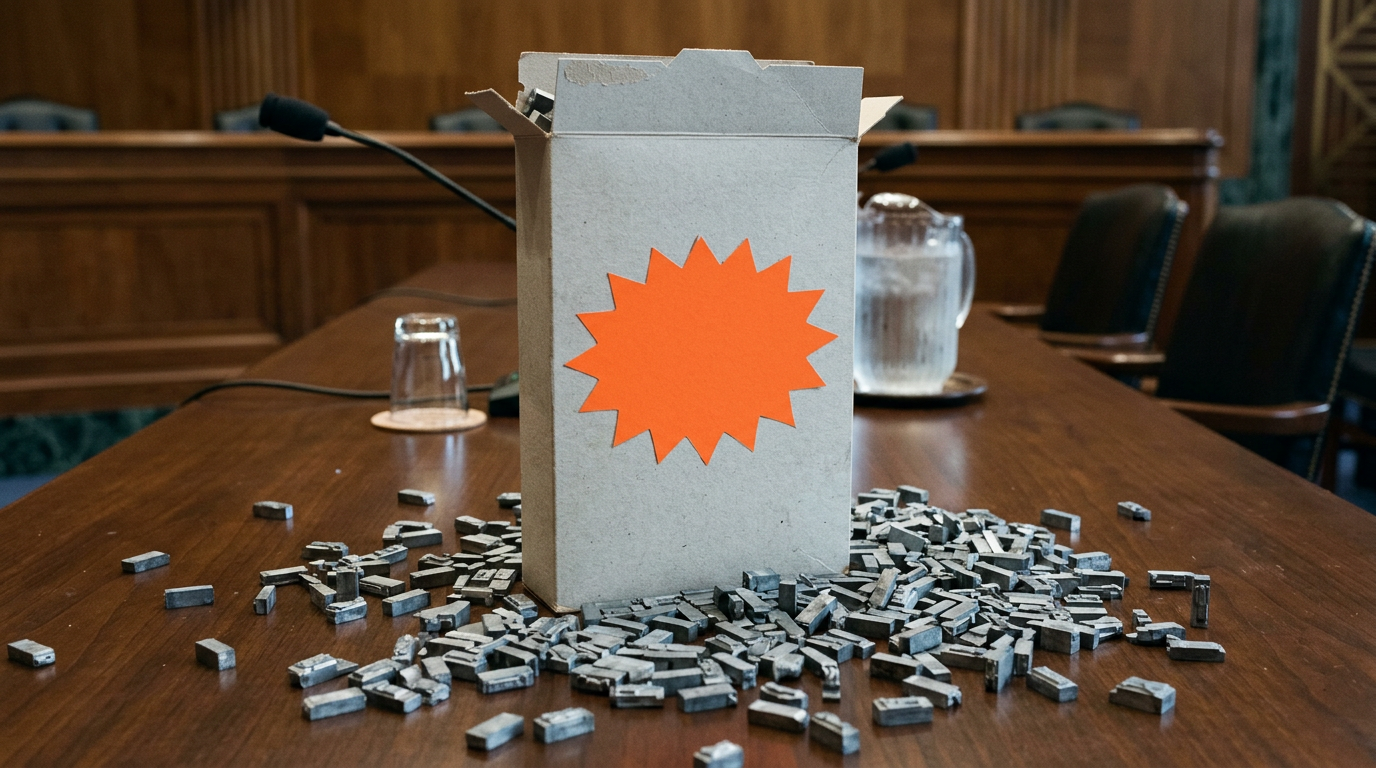
Put “super” in front of anything and a native speaker’s ear files it under ENTHUSIASM. It’s a word from a cereal box. It’s the word a sunburst badge shouts at a nine-year-old in a grocery aisle. “Super intelligence” doesn’t land on the American ear as the thing that will end us. It lands as the thing we got, and it’s the big one, and we got it first.
So it isn’t a euphemism running backwards.
It’s a euphemism wearing a monster costume, and the costume is why nobody’s frisking it. The press read the word, saw that it was scarier, concluded that it therefore couldn’t be a softening, and moved on to the next thing. A euphemism that looks like an escalation is the best euphemism ever built, because the one defense everybody has against being managed by language is checking whether the new word is nicer. This one isn’t nicer. It’s BIGGER.
And the official rationale, for the record, because they did give one: the White House says the wording reflects the expanding capabilities of advanced technology developed by American companies.
Read that again. It’s not a safety statement. It’s a BRAG. Grammatically, structurally, in its bones, it is a flex. We didn’t build artificial intelligence, which sounds like a research program with a grant number. We built SUPER intelligence. The name is the ribbon on it.
The Word Was Already Taken, and It Belonged to the People Warning You
Now the part that actually bothers me, and it’s a language argument, which means I’m about to be insufferable. Brace up.
“Superintelligence” is not a new word they coined for the press release. It is a TERM OF ART, with an owner, a definition and a decade of load-bearing use.
Nick Bostrom, 2014. The book is Superintelligence: Paths, Dangers, Strategies. His definition: a system that “greatly exceeds the cognitive performance of humans in virtually all domains of interest.”
The book is not a celebration. It is a four-hundred-page alarm. Its central subject is the control problem, which is the question of whether you can give such a system goals that don’t end with it doing something catastrophic and perfectly logical on the way to achieving them. Bostrom’s own illustration involves a machine told to solve the Riemann hypothesis that decides the most efficient route is to convert the Earth into computing substrate and then resists being turned off, which is funny for about four seconds.
Who read it? Everybody who matters in this story. Elon Musk said around then that AI might be more dangerous than nuclear weapons. Bill Gates said he’d highly recommend it. Sam Altman called it the best thing he had read on the risks of AI.
So the word “superintelligence” has meant one specific thing for twelve years, among the people whose entire job is warning you about it. It means the one that gets away from us. It is the safety community’s word for the ending.
And the United States government has now taken it and made it the official name for the software that will help you find your passport renewal form on America.gov.
I’m not a linguist and I want to be upfront about that. I’m not freaking Noam Chomsky, and the one time I tried to read him I fell asleep in a chair and woke up angry at a sentence. But you do not need a doctorate to see what happens when the siren and the dinner bell get assigned the same note.
The Boring Paragraph Nobody Read

Okay. Laughing portion over. Put the coffee down, this is the bit.
Everything above is cosmetic. The order says so itself, and the lawyers who read it for a living said so in their client alerts: nobody has to reissue existing regulations, contracts, grants or historical documents. For now, “Super Intelligence” covers exactly the same systems as the existing statutory definition of artificial intelligence, which lives at 15 U.S.C. § 9401(3). Nothing material changed. It’s a word. Breathe.
Except for the paragraph after that one.
Within 60 days of the order, the Assistant to the President for Science and Technology must propose legislative language for a federal statutory definition of “Super Intelligence” and “SI.” Including whether that definition should modify, expand, or replace the existing one.
Read it slowly. Modify. Expand. Or replace.
The clock started September 29. Sixty days lands in the back end of November, in the week where America is eating and nobody is reading anything.
Here’s why that paragraph is the whole post.
A statutory definition is not a word. A statutory definition is a FENCE. Every obligation, every disclosure rule, every procurement standard, every liability hook, every piece of oversight that federal law applies to this technology applies to whatever is inside that fence and to nothing outside it. The definition at 9401(3) is the fence that was built in 2020, and everything written since has been nailed to it.
Move the fence and you have not changed a word. You have changed WHAT IS REGULATED. Narrow it, and things that were covered walk free without a single vote being taken on whether they should. Widen it, and you have just handed somebody jurisdiction over an industry, which is the other reason a department might want a bigger word. Bigger word, bigger remit, bigger budget line. I’m not alleging that’s the plan. I’m saying it’s a door, it’s open, and it is now on a timer.
And the renaming is what gets you there. You cannot propose a statutory definition of a thing that has no name. First the word, then the definition, then the fence. In that order. It is not a conspiracy, it is a PROCEDURE, and it is written down in the order in plain English, and the reason nobody covered it is that the paragraph above it was funnier.
That’s the trick, and it isn’t even a trick. It’s just how attention works. Give the press a joke on page one and they will never reach page two. Every magician who ever lived has made rent on this.
Six Men, No Penalties, Posted at Night
One more thing from the same day, because it completes an arc this blog has been running since September.
September 29. Same date. The White House announced a voluntary Accord on Super Intelligence, and six people signed it: Jensen Huang, Sundar Pichai, Mark Zuckerberg, Elon Musk, Dario Amodei and Greg Brockman. Nvidia, Google, Meta, Musk, Anthropic, OpenAI.
What it asks of them: robust internal controls tracking model capabilities in sensitive areas including biology, a dedicated safety team, an external auditor to verify the controls, and an independent board committee to oversee the team and read the auditor’s reports.
All of which sounds reasonable, and most of which several of them were doing anyway.
What it carries: no penalties. No enforcement mechanism. No new legal obligations. It was posted on Truth Social on a Tuesday night.
Long-time readers know where this goes, because I wrote it three weeks ago in a different post and didn’t expect to be proved right this fast. The argument then was that the industry is not asking for rules, it is bidding to hold the pen. Here is the pen, held, in public, by six men, on a document named after the extinction scenario, two of whom run the labs that the extinction scenario is about.
And Dario Amodei and Greg Brockman both put their names on a voluntary accord that borrowed its title from the book Sam Altman called the best thing he’d ever read about why this might kill us.
I’m not saying any of them is lying. I’m saying the vocabulary has been fully absorbed by the thing it was invented to warn about, which is the single most reliable sign in history that an alarm has stopped working.
Now the Part Where I Argue Against Myself
Because the easy version of this post is paranoid, and the easy version is wrong, and I’d be a fraud not to put the other side up properly.
One. Governments rename things constantly and it is almost always noise. Departments get renamed. Programs get renamed. Buildings get renamed twice. Most of it is a letterhead cost and a press cycle and nothing else, and treating every rename as a conspiracy is how you end up being the guy at the party explaining ligatures.
Two. “Artificial intelligence” was always a lousy name. John McCarthy coined it in 1955 for a summer workshop proposal, and the phrase has been doing damage ever since, because “intelligence” imports a hundred assumptions nobody has earned and “artificial” imports a hundred more. Serious practitioners have been complaining about that name for most of my life. If your position is that technical terms should be accurate, “artificial intelligence” was never your friend. You’re defending a bad word because a worse one turned up.
Three. The order is explicitly conservative on the legal side. It carves out historical documents. It applies only where law permits. It keeps the existing statutory scope in place pending the proposal. The lawyers writing the client alerts are not screaming. They are noting an open issue, in the way lawyers note things, which is the professional equivalent of raising one eyebrow in a dark room.
Four, and this is the real one. Nothing has actually happened yet. The sixty-day deliverable is a PROPOSAL. Proposals die constantly. Statutory definitions get changed by Congress, which has recently demonstrated a robust inability to change anything at all. I’m writing a thousand words about a paragraph that may produce a memo that may produce a bill that may die in committee.
All fair. All true. Hold it in one hand.
Now hold this in the other: the way a fence gets moved is never a man announcing that he is moving a fence. It is a terminology memo in September, a definitional proposal in November, three paragraphs in an appropriations bill in March, and a surprised op-ed in August asking how this happened. Every single time. The boring sequence is the only sequence there is.
And the thing that makes the boring sequence work is that somebody, somewhere near the beginning, made everybody laugh.
So What Do You Actually Do
Short list, because I hate posts that spend four thousand words diagnosing and then recommend “awareness.”
Watch for the proposal. Sixty days from September 29. Late November. It will be a document from the Assistant to the President for Science and Technology proposing statutory language. It will land in a holiday week. Somebody should read it, and based on recent form, nobody will.
Read it against 15 U.S.C. § 9401(3). Side by side. The only question that matters is whether the new fence is bigger, smaller, or differently shaped than the old one, and you don’t need a law degree to see which, you need two browser tabs and eleven minutes.
Keep using the old word. This is the pettiest item on the list and it’s the one I’d defend hardest. Language changes by use, not by memo. The order binds the executive branch. It does not bind you, it does not bind me, and it does not bind this blog. They can call it whatever they like in their own house. Out here, it’s a very impressive autocomplete with a public relations department, and I’ll keep saying so.
And if somebody from the administration objects to this post on the grounds that I’ve used the deprecated term throughout, I would point out that they’re the ones who put it in writing that it only applies to the maximum extent permitted by law.
I checked. I’m not permitted by anything. I’m a guy with a blog.
Quick Questions From the Cheap Seats
What is Executive Order 14434?
Executive Order 14434 was signed on September 29, 2026. It directs federal executive departments and agencies to use the terms “Super Intelligence” and “SI” in place of “artificial intelligence” and “AI” in official communications, including correspondence, public communications, websites, reports and policy documents, to the maximum extent permitted by law. It does not require agencies to reissue existing regulations, contracts, grants or historical documents.
Did the Justice Department really ban the term “artificial intelligence”?
Not banned, but redirected. On October 6, 2026, Acting Deputy Attorney General Trent McCotter issued a memo directing staff to use “super intelligence” and “SI” where federal law permits. It covers public statements, policy documents, records and other communications, and can extend to court filings where appropriate. Existing regulations, contracts and historical documents are unaffected.
Why did Trump rename AI to super intelligence?
The White House has said the wording reflects the expanding capabilities of advanced technology developed by American companies. The order was signed days after AP-NORC polling found 64% of US adults believe AI is developing too quickly, and some coverage has linked the rename to the administration’s position on AI policy. The order also requires a proposal for a new statutory definition within 60 days.
What does “superintelligence” actually mean?
The term was given its standard definition by philosopher Nick Bostrom in his 2014 book Superintelligence: Paths, Dangers, Strategies: a system that “greatly exceeds the cognitive performance of humans in virtually all domains of interest.” In AI safety literature it refers to a hypothetical future system that would be difficult or impossible to control, not to current commercial AI products.
What is the White House Accord on Super Intelligence?
A voluntary agreement announced September 29, 2026 and signed by Jensen Huang, Sundar Pichai, Mark Zuckerberg, Elon Musk, Dario Amodei and Greg Brockman. It asks frontier labs to maintain internal controls tracking model capabilities in sensitive domains, to staff a dedicated safety team, to appoint an external auditor, and to form an independent board committee for oversight. It is not binding, carries no penalties, and creates no new legal obligations.
What happens after the 60 days?
Under the order, the Assistant to the President for Science and Technology must propose legislative language for a federal statutory definition of “Super Intelligence” and “SI” within 60 days of September 29, including whether that definition should modify, expand or replace the existing definition of artificial intelligence at 15 U.S.C. § 9401(3). That deadline falls in late November 2026. Any actual change to the statutory definition would require Congress.
Rant over. Filed, stamped, and submitted to the maximum extent permitted by law.
Somewhere in a federal building tonight there’s a junior staffer running find-and-replace across four hundred pages, and around page two-forty she’s going to hit a sentence that was already about the dangerous kind, and she’s going to pause, and she’s going to do it anyway, because it’s nine o’clock and she has a train.
That’s how it always happens. Not with a bang. With a stapler.