Tim Curry Died and Spotify Wouldn’t Let Me Play Him
Tim Curry Died, and Three Weeks Later I Went for a Run and Couldn’t Play Him
Tim Curry died on August 26th. Eighty years old.
And the minute it landed, my brain did the thing it does, which is to open every drawer at once. Frank-N-Furter, obviously, the fishnets and the absolute contempt in that voice. But also the Lord of Darkness in Legend, which is still, forty years on, the best practical monster makeup anyone has ever put on a human being… enormous, red, horned, and absolutely having a wonderful time. The butler in Clue. Pennywise, who took a generation of children and sold them a lifelong fear of storm drains. Long John Silver, singing, to puppets.
The man had a range like a badly wired amplifier. And I wanted to hear him.
So I went running, pulled up Spotify, and went into my library to find The Rocky Horror Picture Show, which I had downloaded a few months ago.
There it was. Right where I left it. Time Warp. Sweet Transvestite. Dammit Janet. Rose Tint My World. Eddie’s Teddy. I Can Make You a Man. The whole glorious, filthy thing, sitting in my library next to everything else I’d downloaded.
And none of it would play.
Not one track. No connection, no music. Me, out on the road, paying for Premium like a good little citizen, staring at a list of songs I had deliberately put on my phone so that exactly this would not happen.
So naturally I assumed Spotify was having one of its hissy fits. That’s what I said out loud, to nobody, at a jog. “Spotify’s having a hissy fit.”
STOP.
It was not having a hissy fit. And I’m doing the full turn signal here because we’re about to leave my run and end up in a federal lawsuit about gyms, and I’d rather you saw it coming.
Because the answer is not a bug. The answer is written down, in public, by Spotify, in plain English.
The Thirty-Day Leash
From Spotify’s own support page, and I want you to read this the way you’d read a clause in a lease:
“You need to go online at least once every 30 days to keep your downloads.”
That’s it. That’s the whole mystery.
There are other terms in the small print — you can keep 10,000 tracks per device, on a maximum of five devices, and your downloads also vanish if you reinstall the app, or exceed the device limit, or don’t update. But the thirty days is the one that got me.
And I want to be fair here, because there’s a real reason for it. Spotify’s stated rationale is that the check-in lets them collect play data so artists get paid. That is not a villain’s motive. That’s licensing, and licensing is why the service exists at all, and I’d rather artists got paid than didn’t.
But look at what the word “download” is doing in that sentence.
A download is a thing you have. That’s the entire meaning of the word. It came down. It’s here now.
What I actually had was a thirty-day lease that silently renews as long as I keep reporting in. A parole check. And the moment I stopped reporting — which I did, because I hadn’t opened the app in a while, because I’d been listening to audiobooks about biological weapons like a normal well-adjusted man — the shelf emptied itself.
Nobody told me. There was no warning, no “hey, your library expires Tuesday.” The music was just… gone-but-still-listed. Which is somehow worse. A ghost catalog. Titles with nothing behind them.
We Used to Own the Shelf
Here’s the part where I sound like my father and I’ve made my peace with it.
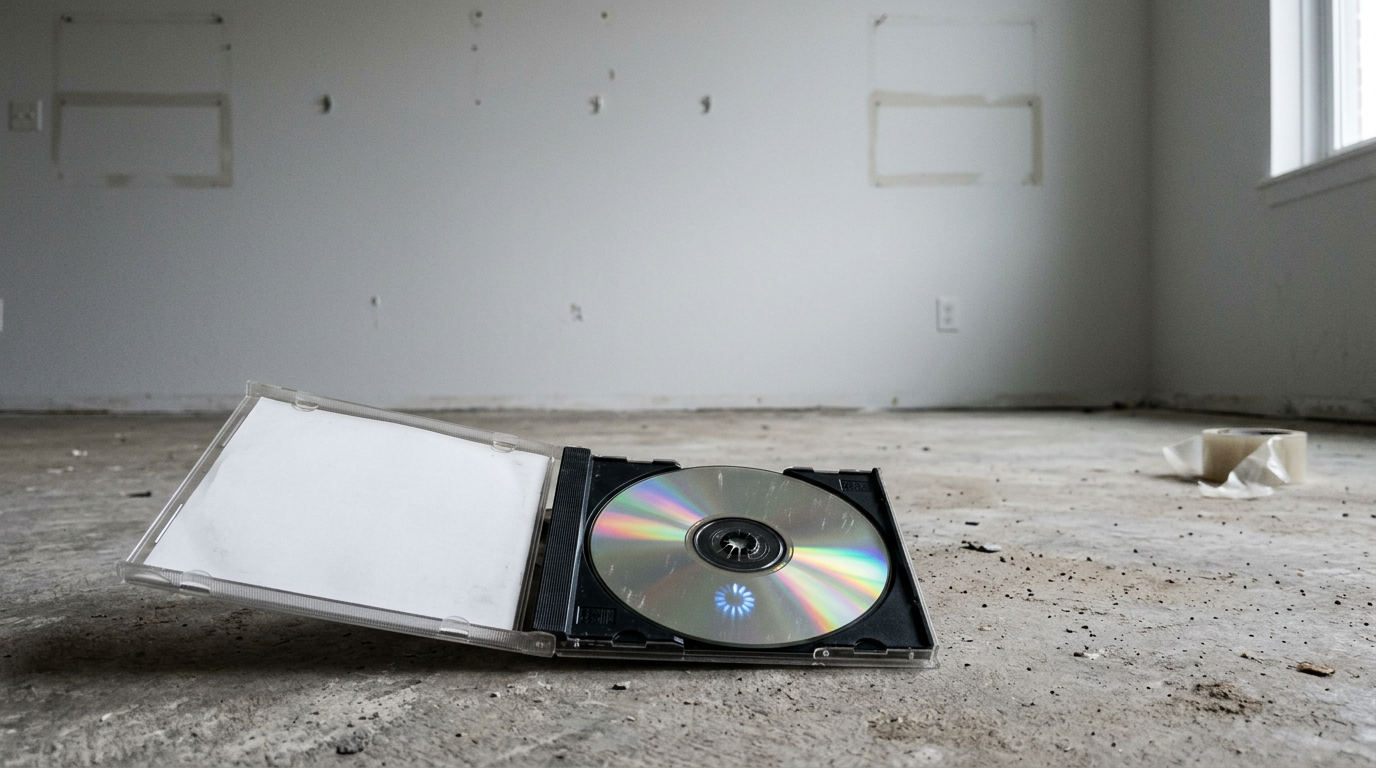
I used to own CDs. An actual physical shelf of them, alphabetized during a phase I’m not going to defend. And that shelf had properties that nobody thinks about until they’re gone:
It worked with no internet. It worked if the company went bankrupt. It worked if I stopped paying anybody anything, forever, which — and this is the part that’s genuinely wild when you say it out loud — is the default condition of a thing you own.
You don’t pay a monthly fee to keep owning your couch.
Now, my entire music library is a login. My films are a login. My books are a login. The photos of my family are a login. The documents I make my living with are a login. And every one of those logins is attached to a card, and every one of those cards is attached to a company whose pricing I do not control and whose terms can change on a Tuesday morning with an email I will not read.
We did not decide to do this. There was no vote. It just happened one autoplay at a time.
The Number You Are Wrong About
And here’s where it stops being a vibe and starts being arithmetic, because somebody went and measured it.
Americans guess they spend about $86 a month on subscriptions.
Itemize it, and the actual figure is $219.
That’s C+R Research. A $133 gap. Call it $1,596 a year that people are spending and genuinely do not know they are spending.
And it holds up across studies. West Monroe found that 89% of consumers underestimated their monthly subscription spending — and 66% were off by more than $200 a month.
Now, honesty requires a caveat and it’s an interesting one. Other surveys come back with much smaller numbers — Self Financial’s 2026 data has the average person holding 3.4 active paid subscriptions at around $35 a month. That looks like a contradiction. It isn’t. It’s a definitions problem, and the definitions problem is the story.
The small number counts what you think of as a subscription. Netflix. Spotify. The gym.
The big number counts what’s actually leaving your account: streaming, music, gaming, fitness, software, food delivery memberships, the cloud storage you needed for one thing in 2022, the thing your printer needs now, the app that used to just be an app.
The reason 89% of people are wrong about the number is that the category keeps eating things that used to be objects.
And Self Financial’s other findings are the quiet tragedy underneath: nearly 60% of people have at least one subscription going completely unused every month, averaging $26.79 of pure waste, and 70% have forgotten to cancel a free trial at some point.
Seventy percent. That’s not a consumer failing. When seven in ten people fail the same test, the test is the product.
John Oliver Got There Before Me
Now, I said out loud that this was John Oliver’s last episode, and it wasn’t, and that one’s on me rather than my phone’s transcription. The “Subscriptions” main story on Last Week Tonight was season 12, episode 22 — August 23, 2025. Over a year ago. Which, if anything, makes it worse: a comedy show did a twenty-minute takedown of this a year ago and the only thing that’s changed since is that I lost Tim Curry off my phone.
But he called it right, and he called it in the way that matters: a “universally annoying problem.” Not a scandal. Not a crisis. Annoying. Which is precisely the register these companies operate in, because outrage gets legislated and annoyance just gets absorbed.
That’s the design. Keep every individual injury small enough that fighting it costs more than eating it. Six dollars here. A forgotten trial there. A library that quietly empties on day thirty-one.
The Cancellation Maze Is Not an Accident

And if you still think the friction is incidental, let me hand you the single best-documented example in America, because the federal government wrote it all down.
On August 20, 2025, the FTC sued the operators of LA Fitness. Over 3.7 million members across 600-plus locations.
Here is what the FTC alleges the cancellation process involved:
You could not cancel by phone. You could not cancel by email. In person or by mail, those were your options. And the mail had to be certified or registered, so getting out cost you money and a trip to the post office.
Staff were trained to refuse phone and email cancellations and to reject requests that got escalated.
At a given club, only one specific employee was authorized to process a cancellation… despite, and I love this detail, multiple employees being perfectly able to sign you up.
Cancellation hours were restricted to times when most people are at work, at gyms that were open up to nineteen hours a day.
And the one that should end the argument about whether any of this is accidental: members who gave up and stopped payment at the bank were, according to the complaint, rebilled under a new account number.
The Rule That Got Cancelled
So the FTC wrote a rule. It was called “click to cancel” — formally the Negative Option Rule — and its central idea was so simple it’s almost funny: if you can sign up in two clicks, you should be able to leave in two clicks.
Took about three years to finalize.
On July 8, 2025, the Eighth Circuit vacated it. Entirely. Days before the compliance deadline. Not on the merits — on procedural grounds, because the FTC hadn’t followed mandatory process requirements in the rulemaking.
Three years of work, killed on paperwork, in the same summer the FTC was suing a gym chain over a mailbox.
And it’s not dead-dead. On January 30, 2026, the FTC filed a draft advance notice of proposed rulemaking to start the whole thing again… which means a comment period, then months of review, then possible hearings, then another comment period, then a final rule. The last version took three years. This one will take at least that, now that they have to be twice as careful.
So the honest status, in 2026, is: there is no federal click-to-cancel rule, there is a plan to maybe have one around the end of the decade, and in the meantime the mailbox is still in the middle of the maze.
The Honest Case Against My Own Rant
Let me take this apart before somebody does it for me, because there’s a real argument on the other side and I use it every day.
Access beats ownership on pure math, constantly. I own maybe four hundred CDs. Spotify has a hundred million tracks. For the price of roughly one album a month I get all of it, plus discovery, plus it’s on every device. I am not giving that up and I’d be a liar to pretend I was considering it.
My CD shelf was also a liability. It got scratched. It got lost in a move. Two people I lent things to in 2003 still have them and we both know who they are.
And the thirty-day check-in genuinely isn’t malice. It’s a licensing requirement. The alternative — permanent offline copies — is the thing the entire industry spent the 2000s in court about.
So no, I don’t want to go back. That’s not the argument.
The argument is narrower and I think it survives all three objections: I should have known. The word “download” was doing work it hadn’t earned. The countdown was running and I couldn’t see it. There was no notice on day twenty-nine, and there is no reason there couldn’t have been, except that a notice reminds you what you don’t actually have.
Call the thing what it is and I’ll keep paying happily. Keep calling a lease a download and I’m going to keep noticing.
What It Actually Is
We didn’t move from owning to renting. That’s the version that’s easy to say and it’s not quite right.
We moved from owning to access to permission.
Owning is a thing you have. Access is a thing you pay for. Permission is a thing that can be withdrawn, changed, repriced, or quietly allowed to expire on day thirty-one while you’re out on a run thinking about a dead actor.
And the tell is always the exit. You can measure exactly how much you own something by how hard it is to leave. Two clicks in, certified mail out.
Tim Curry spent his whole career playing characters who refused to be contained by the rules of the picture they were in. Frank-N-Furter breaks the fourth wall, the floor, and several laws. Darkness will not stay in the dark.
And now the film’s soundtrack lives on a thirty-day timer on a device I paid for, in a library I curated, next to a spinning wheel.
Don’t dream it, be it. Preferably on media you actually possess.
Quick Questions From the Cheap Seats
Why do my Spotify downloads disappear?
Spotify requires you to connect to the internet at least once every 30 days to keep downloaded content. Its support documentation states plainly: “You need to go online at least once every 30 days to keep your downloads.” Downloads are also removed if you reinstall the app, exceed the five-device limit, or fail to update. The stated reason is that the check-in lets Spotify collect play data to pay artists.
How much does the average American spend on subscriptions?
Estimates vary by definition. C+R Research found people guess around $86 a month while an itemized tally comes to $219 — a gap of roughly $1,596 a year. West Monroe found 89% of consumers underestimate their monthly total and 66% are off by more than $200. Narrower surveys counting only obvious subscriptions land nearer $35 a month across 3.4 services.
What happened to the FTC’s click-to-cancel rule?
The Eighth Circuit vacated the FTC’s Negative Option Rule in its entirety on July 8, 2025, days before its compliance deadline, on procedural grounds rather than the merits. The FTC submitted a draft advance notice of proposed rulemaking on January 30, 2026 to begin the process again. As of now there is no federal click-to-cancel rule in force.
Why did the FTC sue LA Fitness?
The FTC filed suit on August 20, 2025 alleging that operators of LA Fitness made cancellation unreasonably difficult for over 3.7 million members. Allegations include restricting cancellation to in-person or certified mail only, limiting cancellations to a single authorized employee per club, restricting cancellation hours to times most members work, training staff to refuse phone and email requests, and rebilling members under new account numbers after they stopped payment.
Do you actually own music you buy from a streaming service?
No. Streaming services grant a revocable license to access content, not ownership of a copy. A purchased physical copy carries first-sale rights — you can resell, lend, or bequeath it. A streaming library depends on continued payment, continued licensing agreements between the service and rights holders, and in Spotify’s case a check-in at least every 30 days. The exit is always the tell.
When was John Oliver’s subscriptions episode?
The “Subscriptions” main story aired on Last Week Tonight season 12, episode 22, on August 23, 2025, where he characterized subscription practices as a “universally annoying problem.”
Rant over. Not sorry, and going to go buy a CD out of pure spite.
Somewhere there is a shelf with my name on it and nothing on that shelf needs permission to exist,
which is the whole point.