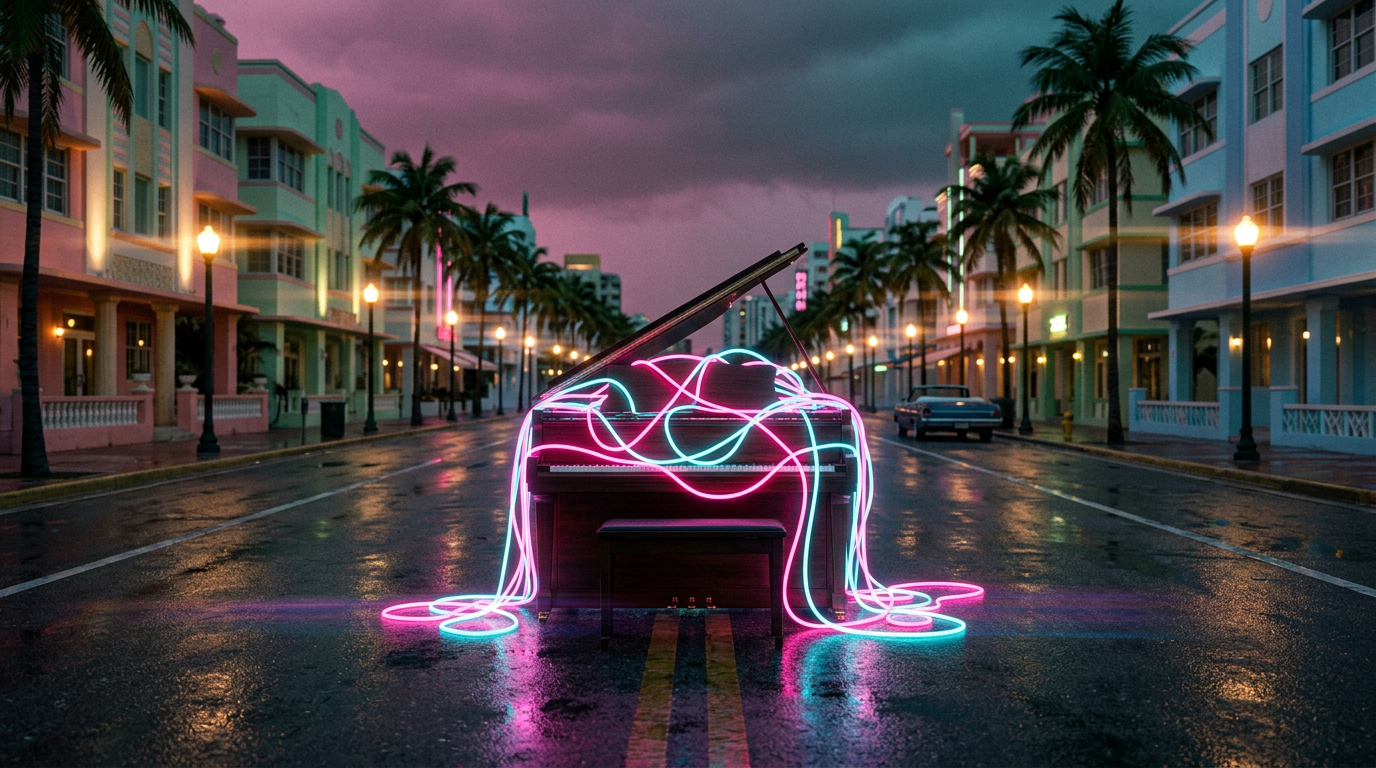
The Piano Kid, the Trunk, and Billie Jean: How a Game About Committing Crimes in Fake Miami Became the Most Expensive Thing Anyone Has Ever Made
Summer, 2002. Sixteen years old. We had rented a cabin in the woods that was so aggressively wholesome it could have been painted by Norman Rockwell — porch, pines, screen door with a spring on it, the whole apple-pie apparatus.
And into this Rockwell canvas came my friend, whose mother had spent his entire adolescence surgically removing joy from his calendar and replacing it with scales.
You know this kid. Straight-laced. Straight-shooting. Straight-everything. A wound-up gerbil who did not know a Metal Gear Solid snake if one crawled up and bit him. Every window of unsupervised recreation in his life — every single one — his mother had spotted from across the house, walked over, and filled with a metronome and a bench.
That summer the leash came off, and we invited him along.
He does not unpack. He does not say hello. He comes through the door of our shared room at a dead sprint and announces that we need to get a copy of Grand Theft Auto: Vice City.
Now. I was and remain an enormous game nerd. But this is 2002 and we do not have the internet in any sense you would recognize, so I am running on month-old magazine information and rumor.
So I look at him and I say — and I want the record to reflect the exact words —
“You know I don’t like NASCAR games.”
He stops. Genuinely thrown. “It’s not a NASCAR game.”
“Well what’s it about? I don’t like auto games.”
And here the piano kid pauses. He actually considers the question. You can see his noggin weighing how to explain this to a friend. How to make the argument sink in fast. Loading the summary. Selecting the two details that will land.
And then he says:
“Well, it’s about running over people, getting hookers, there’s a porn studio with Dennis Hopper — you know the guy from Speed. You steal cars, you shoot people, you put bodies in your trunk.”
I say what?
And he says:
“Yeah. And listening to Billie Jean on the radio.”
Reader, we were on our bikes inside of ten minutes like crazed road runners heading over to Blockbuster with $70 smackers, most of it coins we “borrowed” from my mum’s handbag.
STOP.
Because I have to tell you what I found out this week, and it’s going to sit on top of the rest of this whole thing like a hand on your shoulder.
Billie Jean isn’t in Vice City anymore.
Hold that. We’re coming back to it. First, the machine.
What That Game Actually Was
Vice City hit in October 2002 and it was not a game so much as a haunting.
It was Miami in 1986. Not “inspired by.” Miami. Pastel deco hotels, palm trees bent in the sea wind, cocaine money soaking through the drywall, that sky that goes magenta and teal at the same time and looks fake even when you’re standing under it. Scarface and Miami Vice fed through a wood chipper and reassembled by Scottish programmers who had, as far as anyone can tell, correctly diagnosed America from four thousand miles away.
And the cast. Good lord, the cast.
Ray Liotta as Tommy Vercetti — actual Ray Liotta, doing actual work, in a video game, in 2002, when that simply was not a thing that happened. Burt Reynolds as a property developer. Dennis Hopper as a sleazebag film director. Luis Guzmán as Ricardo Diaz, a man permanently one bad minute from screaming. Danny Trejo. Gary Busey. Debbie Harry on the radio. Lee Majors.
Rockstar took a medium that Hollywood considered a toy and hired the cast of a Michael Mann picture to be in it.
It sold about 17.5 million copies, which in 2002 was an absurd number, and it did something more important than sell: it convinced a very large number of people that this medium could have a voice. A point of view. An opinion about America.
The Machine It Became
Fast forward, and the numbers stop being numbers and become weather.
GTA V, released 2013, has now sold over 230 million copies as of Take-Two’s August 2026 earnings call. Two hundred and thirty million. That’s more than the population of most countries on earth. The franchise as a whole is past 475 million units.
At launch, GTA V grossed roughly $815 million in its first 24 hours and passed $1 billion in three days — a Guinness World Record, and at the time the fastest any entertainment product in any medium had ever gotten there. Not fastest game. Fastest anything. Films included.
That is a thirteen-year-old game that people are still buying this quarter.
And now GTA 6, landing November 19, 2026 — roughly ten weeks from when I’m typing this — after a delay that generated more discourse than most national elections.
The reported budget is between one and two billion dollars. For scale, the previous most-expensive game ever made is generally reckoned to be Spider-Man 2 at around $315 million. GTA 6 is somewhere between three and six times that.
The first trailer, dropped in December 2023, set three Guinness World Records in 24 hours, including most-viewed video game reveal on YouTube at around 90.4 million views in a single day. It went on past 268 million, beating the trailer for Avengers: Infinity War.
A video game trailer beat a Marvel movie trailer. Sit with that for one second and then keep walking.
Analyst projections for launch: something like 25 million units on day one, a billion or more in revenue in under 24 hours — which would take GTA V’s three-day record and cut it to less than one. Somebody has even bothered to estimate the lost U.S. workplace productivity on launch day at around a billion dollars.
So Why Are People Actually Losing Their Minds
Three reasons, and only one of them is the game.
One: scarcity in a world that has none of it. We established in another post that the movies stopped feeling like events because we made them permanently available. GTA did the exact opposite by accident. Thirteen years between installments. No annual release. No live-service treadmill dribbling out content. Rockstar disappears into a bunker for over a decade and comes back. That is the last genuine event structure left in mass entertainment, and it works for exactly the reason everything else stopped working.
Two: it’s the only mirror we’ve got that’s allowed to be mean. GTA’s actual product has never been crime. It’s satire. It is the one enormous, mainstream, mass-market American cultural object that is permitted to be openly contemptuous of America — the strip malls, the talk radio, the wellness grifters, the real estate developers, the cops, the ads. Trailers for 6 show a fake social feed, parody luxury brands, a dollar bill reading “United States of Paranoia.” No studio would greenlight that as a film in 2026. It arrives inside a game and nobody blinks, because it’s “just” a game, which is precisely the cover that lets it say things nothing else can.
Three: it’s going home, and home is different now. GTA 6 returns to Vice City, in the state of Leonida, with the Everglades out back and alligators in the water. And the lead is Lucia Caminos — the first playable female protagonist in the series’ history, introduced fresh out of prison with an ankle monitor on.
That’s the part I find genuinely interesting, and the part the discourse is largely fumbling. The commentary around this launch remains overwhelmingly about cars, guns and strip clubs — the franchise’s own greatest hits, recited back at it — while the actual creative swing is a Latina lead in a Miami crime story. In 2002, Vice City’s Miami was an exotic pastel fever dream that most of America watched from a distance. In 2026, Miami is the American mainstream. The joke has moved to the center of the country.
The Song They Legally Erased
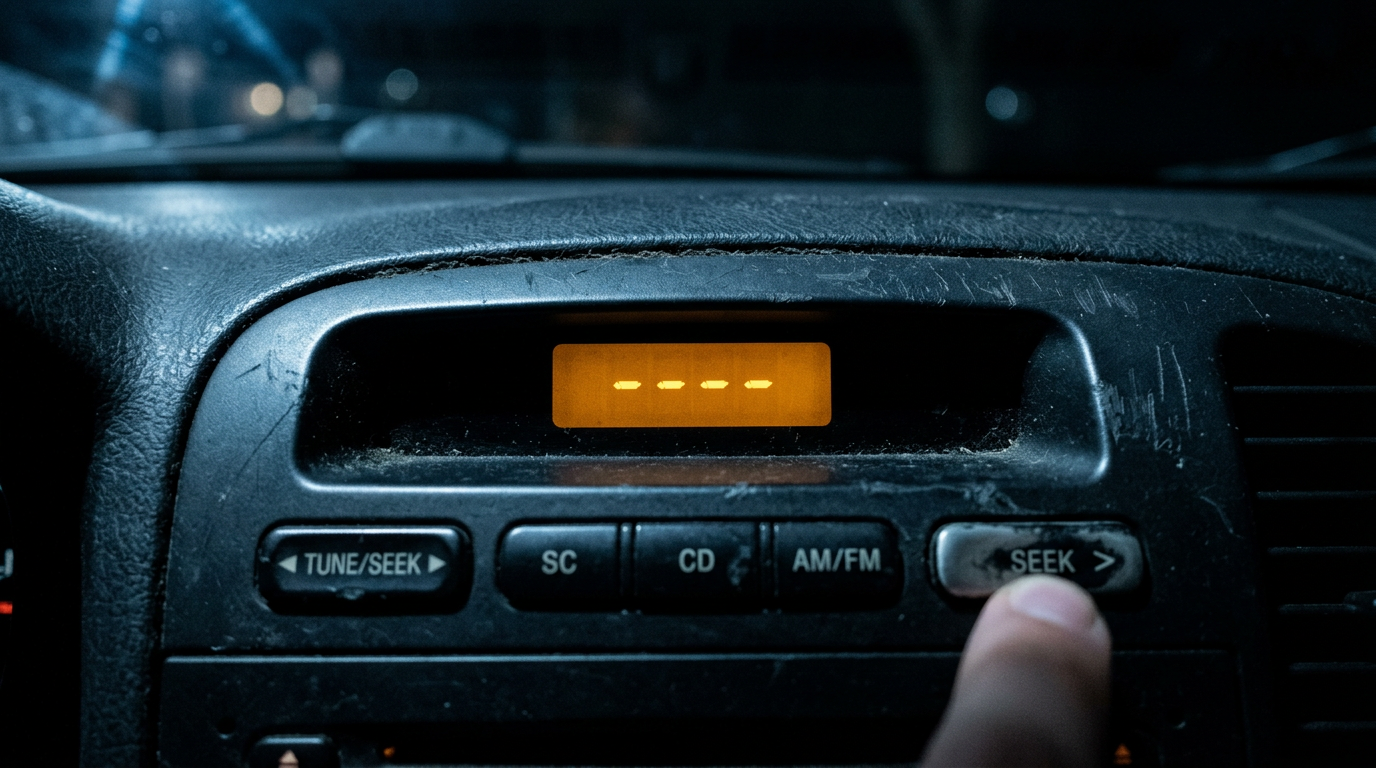
Okay. Back to the hand on your shoulder.
That kid sold me the game on two things. Bodies in the trunk, and Billie Jean on the radio. That was the pitch. Those two details, in that order, made a sixteen-year-old get on his bike.
You cannot buy that game anymore.
Oh, you can buy Vice City. It’s right there. But when the music licenses expired, the songs came out. Both Michael Jackson tracks — gone from the PS3 re-release, with Billie Jean’s slot on the radio quietly handed to Laura Branigan’s “Self Control.” By the tenth-anniversary version, five more were gone: Kate Bush, Ozzy Osbourne, Herbie Hancock, Afrika Bambaataa, Tyrone Brunson. Lionel Richie only ever existed on the original PS2 discs.
The most valuable entertainment franchise on the planet — half a billion units sold, a company that can spend two billion dollars on a single title — cannot legally reproduce its own memory.
Not won’t. Can’t. The rights lapsed. The soundtrack that made that world feel like a real place was rented, and the lease ran out, and the thing that got erased was not a feature. It was the atmosphere. It was the reason you drove the long way around the island instead of taking the bridge.
And here’s the part that should worry anybody buying anything in November: this is now the default condition of everything. Every game with a licensed soundtrack is on a clock. Every film on a streamer is one contract renewal from vanishing. Every digital library you’ve built is a permission slip that can be revoked by people you’ll never meet, for reasons that will never be explained to you, in a press release nobody writes.
Twenty-four years ago a kid who wasn’t allowed to have fun described a game to me using a stolen car, a corpse, and a Michael Jackson song. Two of those three are still in there.
Where This Actually Lands
I don’t think the GTA 6 hysteria is stupid. I think it’s the healthiest signal in entertainment right now, and I think the film industry should be studying it with real alarm.
Rockstar did the thing everyone else stopped doing. They made you wait. They refused to feed the machine on the machine’s schedule. They put over a decade and reportedly a billion-plus dollars into one enormous swing with a point of view, and then — this is the important part — they didn’t tell you what was in it. Two trailers in three years. That’s the entire marketing plan for the most expensive object ever built by human beings.
Compare that to a $700 million Marvel picture that has shown you nine minutes of itself before you’ve bought a ticket.
Scarcity, patience, a real perspective, and the nerve to be unpleasant about the country that’s buying it. That’s the formula. It’s not a secret. It’s just extremely hard, and it requires a decade of holding your nerve while the market screams at you to ship something.
So yes, I’ll be there on the 19th of November. And somewhere out there is a man who was once made to practice scales every day of his childhood, and I hope he’s playing too, and I hope somebody’s radio still works.
Quick Questions From the Cheap Seats
When does GTA 6 come out?
November 19, 2026, after a delay from the originally announced window. Rockstar publicly apologized for the delay when confirming the date.
How much did GTA 6 cost to make?
Reported estimates run between $1 billion and $2 billion, which would make it the most expensive entertainment production ever made in any medium. For comparison, the previous record-holder among games is generally cited as Spider-Man 2 at roughly $315 million.
How many copies has GTA V sold?
Over 230 million as of Take-Two’s August 2026 earnings call. The GTA franchise as a whole has passed 475 million units.
What records does GTA V hold?
It grossed approximately $815 million in its first 24 hours and $1 billion within three days — a Guinness World Record, and at the time the fastest any entertainment product had reached that figure. Analysts expect GTA 6 to break it by clearing $1 billion in under a day.
Why was Billie Jean removed from GTA Vice City?
Music licensing expired. Both Michael Jackson tracks were cut from the PS3 re-release, with “Billie Jean” replaced by Laura Branigan’s “Self Control.” The tenth-anniversary release also removed songs by Kate Bush, Ozzy Osbourne, Herbie Hancock, Afrika Bambaataa and Tyrone Brunson. The original soundtrack exists intact only on the original discs.
Who is the GTA 6 protagonist?
The game features a dual-protagonist structure with Lucia Caminos and Jason. Lucia is the first playable female lead in the mainline series, introduced fresh out of prison and wearing an ankle monitor.
What celebrities were in GTA Vice City?
Ray Liotta voiced protagonist Tommy Vercetti, alongside Burt Reynolds, Dennis Hopper, Luis Guzmán, Danny Trejo, Gary Busey, Debbie Harry and Lee Majors — an unusually starry cast for a 2002 video game, and part of why the release was treated as a cultural event.
Rant over. Absolutely not sorry.
Two of those three details are still in the game. The third one is on a shelf in a warehouse somewhere, owned by people who have never played it.
Back up your discs.