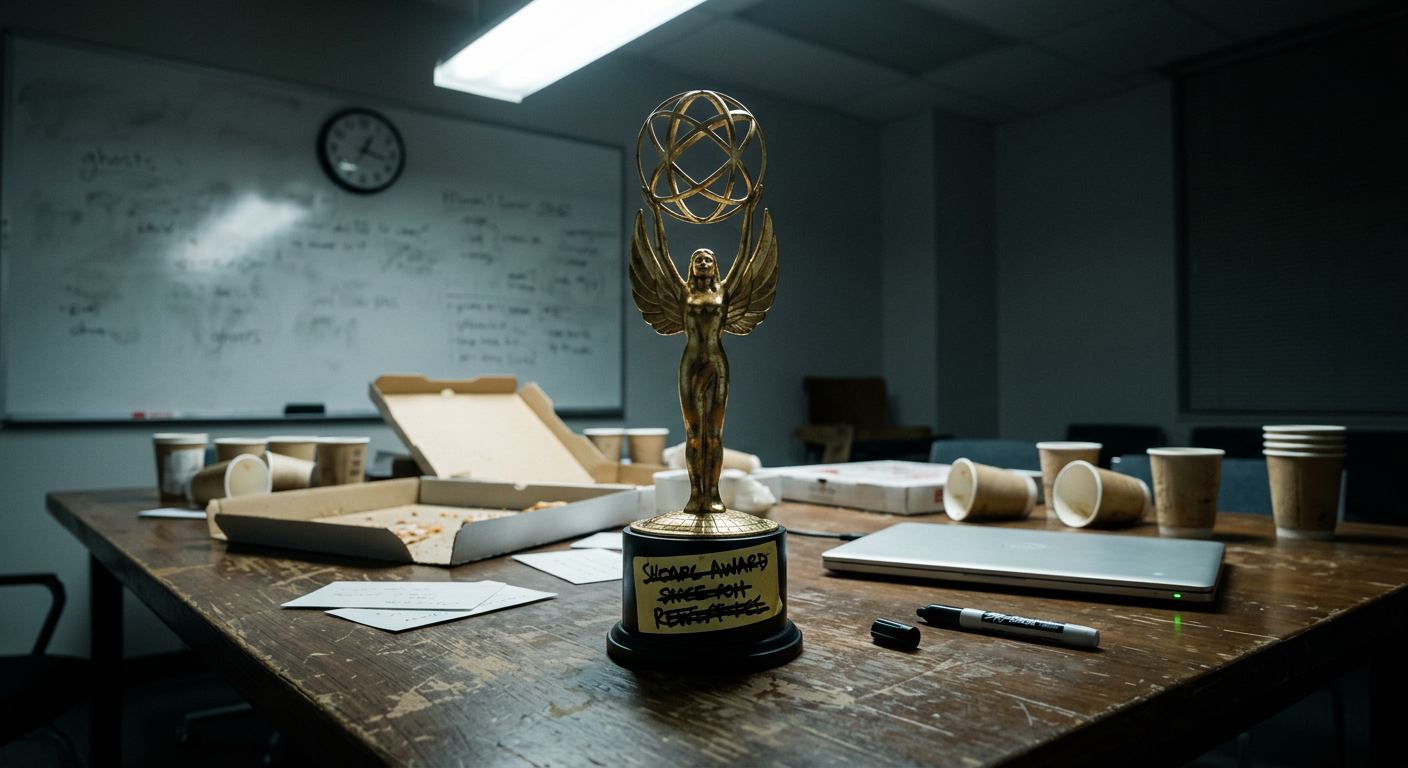
South Park Won an Emmy, Posted a Naked Trump Holding It, and Then Renamed the Entire Show Within Twenty-Four Hours. Let’s Talk About the Clock.
Part of The Attention Machine · Chapter 1 of 7 →September 7th. Outstanding Animated Program. South Park takes the Emmy for Sermon on the ‘Mount — the season 27 premiere, the one where they put an unclothed Donald Trump on basic cable and let him lie there.
First Emmy the show has won in that category since 2013. Thirteen years in the wilderness. A show old enough to rent a car.
And what do they do with it?
They post a picture of a pants-less Trump holding the statuette, and they caption it: “You finally got your Emmy.”
Now. If you don’t know why that’s a scalpel and not a hammer, here it is: Donald Trump was nominated for an Emmy for The Apprentice. He did not win. He has been publicly, repeatedly, loudly annoyed about this for the better part of twenty years — it is one of the most reliably documented grudges in American public life.
So they won an award for making fun of him, and then handed him the award in a JPEG, with his pants off.
That’s not a joke. That’s a surgical strike.
And then — and this is the part that made me stop and actually think instead of just laugh —
The next day they renamed the show.
South Park is becoming South America, and the stated reason is that they were “inspired by the bravery and patriotism of Apple and Google,” who rolled over and relabeled Lake Ontario as Lake America on their maps when the administration asked.
Emmy Sunday. Rebrand Monday. Turnaround: about twenty-four hours.
STOP.
Because before I get into the machine, I have to tell you about my wife, and about the number sixty-seven.
The Wife Test
My wife does not open a newspaper. This is not a criticism, it’s an operating parameter. Culture reaches her the way light from dead stars reaches Earth — real, accurate, and arriving considerably after the event.
I have told her for years: if you want to know what a new boogeyman is, watch South Park. It’s not a comedy show. It’s a dispatch.
Couple of days ago she comes to me holding her phone like she’s found the Ark of the Covenant. It’s an Instagram clip — a news segment, here in Argentina — where a broadcaster has brought in a pop culture expert to explain to the nation what “6-7” means and what “aura farming” is.
An expert. Flown in. To explain a hand gesture.
And I looked at her and said: South Park did that. About a year ago. And they explained it properly.
I checked, because I wanted to be sure I wasn’t being smug with bad data. South Park covered 6-7 in the season 28 premiere, “Twisted Christian,” which aired October 16, 2025 — an episode about children getting brainwashed by the meme.
That’s eleven months before an Argentine news desk needed a specialist to explain it on air.
And here’s the kicker: the meme wasn’t obscure. It came out of Skrilla’s track Doot Doot (6 7), got welded onto LaMelo Ball — a man who is six foot seven — bounced through basketball edits, exploded when a kid at a game screamed it, and then Dictionary.com named “67” its 2025 Word of the Year. Their description was almost tender: “a burst of energy that spreads and connects people long before anyone agrees on what it actually means.”
Dictionary.com got there. The Argentine news got there in September 2026.
South Park got there in October 2025, and made a whole episode about what it meant rather than what it was.
That gap — eleven months — is the entire subject of this post.
The Six-Day Machine
Here’s how they do it, and it is genuinely one of the great production feats in television.
South Park runs a six-day cycle. Not six weeks. Six days. There’s a documentary about it — 6 Days to Air, 2011 — and watching it is like watching a controlled demolition from the inside.
Thursday: the room sits down with nothing. In the documented episode, Trey Parker was annoyed about the iTunes terms and conditions that morning, so that became the show — HumancentiPad. Then everything happens simultaneously. Script, voice records, animation, music, all of it in parallel, all of it on top of each other.
Tuesday — the day before it airs on national television — Parker is still writing. The script is not finished. The staff is prepping for an all-nighter.
Wednesday, just after 7 a.m., the episode is done. Audio and picture lock in the afternoon. The master gets rushed to Comedy Central in New York hours before it goes out to the country.
That’s it. That’s the weapon.
Not the crudeness. Not the shock. Everyone fixates on the crude jokes and misses that the actual innovation is logistical. Every other show in television operates on a six-to-nine-month lead time, which means every other show is shipping commentary on a world that has already left the building. They are photographing a room after everyone went home.
South Park is the only scripted show on earth that operates at the speed of a news desk. It is functionally a John Oliver monologue that happens to be animated — same relationship to the present tense, same “this happened Tuesday and we’re on it Wednesday” metabolism.
A Brief and Incomplete History of Getting Rendered
The catalogue of people this show has run through the machine is genuinely staggering, and the range is the point.
Barbra Streisand, 1998, season one — turned into Mecha-Streisand, a kaiju, a giant robot monster stomping the town, in the twelfth episode they ever made. They were not famous yet. They did it anyway.
Kanye West, 2009, “Fishsticks” — and I want to correct the record here because I’ve told this story wrong at parties for years. He doesn’t become a dolphin. He becomes a gay fish. An entire episode built on a man who cannot understand a pun, escalating until he is swimming in the ocean, in love, singing about it. It remains one of the most efficient character assassinations ever animated, and the extraordinary thing is it wasn’t even cruel — it was diagnostic.
Towelie, 2001 — a talking towel who is permanently high, invented specifically to satirize cynical merchandise-driven characters, who then became a beloved merchandise-driven character, which is a joke that took twenty-five years to fully land and is still landing.
And then the thing that stops being a joke and becomes a life: Casa Bonita. Parker and Stone loved a decaying Colorado Mexican restaurant-slash-cliff-diving-attraction so much they immortalized it in an episode, and then, when it went under, they bought the actual building and poured a fortune and several years of their lives into restoring it. Two guys who make dick jokes for a living spent a chunk of their fortune saving a fake Mexican restaurant with an indoor waterfall because it mattered to them as children.
That’s the range. Kaiju Streisand to a stoned towel to genuine architectural preservation, from the same two people, over twenty-nine years.
What Actually Happened This Summer
Right, so the current run. Because the context makes the Emmy troll about ten times better.
In July 2025, Paramount signed South Park to a reported $1.5 billion, five-year streaming deal.
This is the same Paramount that had just settled a lawsuit with Trump over a 60 Minutes edit, in the middle of a merger that needed federal approval, and had just cancelled Stephen Colbert.
So Parker and Stone take the billion and a half dollars.
And then, days later, they air Sermon on the ‘Mount — an episode that torches Trump, torches Paramount, and puts the President of the United States on screen with no clothes on.
It pulled almost six million viewers and broke a 26-year audience record for the show. The White House issued an official response. An actual government statement, about a cartoon.
And that is the episode that just won the Emmy on Sunday. And then got used as ammunition on Sunday night. And then got followed by a show-wide rebrand on Monday.
The whole sequence — deal, episode, record, White House statement, Emmy, troll, rename — is maybe the most complete demonstration of that six-day metabolism ever run in public.
Now Here’s My Actual Problem
This is where I turn the camera around, because this is what I do for a living and this week has been sitting in my chest.
We build AI content systems. That’s the work. And the thing AI has genuinely, unambiguously delivered — the thing that is not hype, not a demo, not a promise — is the six-day machine, for everyone.
Something happens on a Tuesday. By Tuesday night we can have the script, the voice, the images, the cut, the music, the whole finished object. Not a rough version. A finished one. The production wall that made topical content the exclusive property of shows with a hundred-person staff and a Comedy Central budget — that wall is gone. It fell over. Nobody’s talking about it enough.
So we have the clock now.
We do not have Trey Parker.
That’s the hole, and it’s not a small one, and no amount of compute closes it. What South Park has that we don’t is a person who can look at an iTunes terms-of-service agreement at nine in the morning and immediately have the angle. Not eventually. Not after a workshop. Immediately, and correctly, and with a point of view sharp enough to be worth animating.
John Oliver’s room has it. That’s not a research skill. That’s not a prompt.
Now that it’s cheap, the shortage is visible, and the shortage is exactly where it always was. It’s the person. It’s the angle. It’s whatever it is that lets somebody see a company rename a lake to flatter a president and think, within about four seconds, we should rename the show.
You cannot generate that. You can only find it, pay it, and get out of its way.
The Honest Version, Where I Take My Own Argument Apart
Three things I’d push back on if somebody else wrote the above.
One: South Park’s speed isn’t really about tooling. It’s about authority. Two men can rewrite the script twenty hours before broadcast because there is nobody above them who can say no. No notes. No standards call. No brand safety review. Give a corporate content team the fastest AI stack ever built and they will still take five weeks, because four of those weeks are approvals. The bottleneck in most organizations was never production. It was permission, and AI does not ship with permission.
Two: fast and topical is mostly bad. Topical work rots. For every Sermon on the ‘Mount there are a hundred thousand pieces of same-day reaction content that are worthless within a week and were worthless when they were made. The six-day cycle is only a superpower if a Trey Parker is standing at the front of it. Without one, it’s just a firehose pointed at your own foot, and AI has made that firehose free.
Three: it might be running out. The show is on season 29. Parker and Stone are in their mid-fifties and have said out loud how much the pace costs them. The Casa Bonita documentary is substantially about two men nearly losing their minds. Nothing runs at this tempo forever, and I don’t think anyone should build a business theory on the assumption it will.
But the number stands: eleven months between South Park explaining 6-7 and an Argentine news broadcast needing a consultant to do the same.
That’s not a gap in technology. Everybody had the same eleven months.
That’s a gap in somebody being awake.
Quick Questions From the Cheap Seats
Why is South Park changing its name to South America?
The creators announced the rename as satire of the administration’s geographic renaming push, saying they were “inspired by the bravery and patriotism of Apple and Google” — companies that complied when asked to relabel Lake Ontario as “Lake America” on their maps. It follows the same pattern as the Gulf of Mexico being renamed the Gulf of America.
Did South Park win an Emmy in 2026?
Yes. On September 7, 2026, “Sermon on the ‘Mount” won Outstanding Animated Program — the show’s first win in that category since 2013’s “Raising the Bar.”
What was the South Park Trump Emmy joke?
After the win, the show’s account posted an image of a pants-less Trump holding the Emmy with the caption “You finally got your Emmy” — a reference to Trump’s long-running grievance over never winning one for The Apprentice, which he was nominated for but did not win.
How long does it take to make a South Park episode?
Six days, start to finish. The 2011 documentary 6 Days to Air shows the script still unfinished the day before broadcast, the episode completing just after 7am on air day, and the master being rushed to New York hours before it goes out.
What South Park episode is about the 6-7 meme?
“Twisted Christian,” the season 28 premiere, aired October 16, 2025. The 6-7 trend came from Skrilla’s 2024 track Doot Doot (6 7), and Dictionary.com later named “67” its 2025 Word of the Year.
Did Kanye West turn into a dolphin on South Park?
No — a fish. In “Fishsticks” (2009), Kanye’s inability to understand a pun escalates until he declares himself a “gay fish.” The dolphin thing is a very common misremembering, and I have personally been guilty of it for about fifteen years.
Rant over. Not sorry, not now, not ever.
Somewhere in Colorado two men in their fifties are going to spend next Tuesday night awake, rewriting something that airs Wednesday, and it will be about a thing that happened on Monday.
Be awake on Monday.