Iran Didn’t Need to Win the War. It Just Had to Wait.
Part of The Language of Power · Chapter 4 of 4 →The Ghost of Robespierre Pulled Into a Gas Station, and Somewhere in Tehran a Plastic Man Started Laughing
Saturday, the ghost of Robespierre came back to France, and nobody had the decency to remind him how it ended for him the first time.
He didn’t bring the Terror. He brought the greatest hits. Cars burning along the Canal Saint-Martin. Banks smashed. A Lacoste boutique ransacked, the little crocodile finally seeing some action. In Limoges, the city hall set ablaze. In Marseille, black-clad protesters broke into City Hall and redecorated it in the anarchist style, which is spray paint with feelings. In Lyon they torched the tourist office, which is either a political statement or the most aggressive one-star review in human history… and if you’ve ever paid for a walking tour of anything, you’re not entirely against it.
A bingo card of revolutionary tactics. Every square stamped. The card had been sitting in a drawer since 1789 with the guillotine folded up next to it like a beach chair, waiting for somebody to blow the dust off the blade.
And madness, as everyone who has attended a family wedding knows, is contagious. By evening it had hopped the Alps. In Milan, a march against the cost of living came apart and police cleared the square in front of the cathedral with tear gas. On Sunday Milan went again: stones, looted shops, smashed windows around the Duomo, and more than 200 people detained. Bologna got water cannons. Brussels, Lisbon and Albania all had their own versions going. And in southern Italy, truck drivers blocked roads in protest at fuel prices that the coverage tied directly to the war in Iran. Remember the truckers. They’re the thread this whole post hangs on.
Pay attention, you doomscrolling sack of gristle. This is the part where it gets interesting, and you’re going to want to have finished your coffee.
The Guillotine Was Always in the Garage
The reason for all this, we’re told, is simple: the cost of living and the price of fuel. People got fed up.
That’s mostly right, and the full version is better, so let’s do it properly.
This didn’t start with fuel. It started last month in high schools in the working-class northern suburbs of Paris, where kids got angry about teacher shortages and classrooms falling to pieces. Kids. Then it grew a beard, put on a high-visibility vest and became a movement about inequality, public spending and the price of everything. A 19-year-old protester in Paris named Lola laid it out to Reuters in three parts: life costs too much, fuel costs too much, and students are getting hurt for asking for teachers.
The numbers depend on who you ask, which is how you know it’s a real French protest. The Interior Ministry counted about 550,000 people marching on Saturday, 110,000 of them in Paris. The CGT union counted 800,000. Somewhere between those two figures lies the truth, probably drinking a small coffee and refusing to take sides.
The weekend’s bill came in on Monday. Nearly 2,400 arrests nationwide. Roughly 1,000 police and security officers injured. Business losses running into the hundreds of millions of euros. Interior Minister Laurent Nuñez went on television and admitted police “lost control” in some cities, which is not a sentence an interior minister says for fun. And one protester in Paris died of cardiac arrest during the demonstrations, according to police. No joke goes there. That’s a person.
It isn’t over, either. The yellow vests have called a “second act” for Saturday, October 24, another the week after, and a major demonstration on November 5. The minority government faces a budget vote on Tuesday. The bingo card has a second page.
The government’s line is that the violence was the work of a fringe. Prime Minister Sébastien Lecornu blamed the far left and plain criminals, and said nobody would impose a political agenda through violence. Macron vowed to prosecute. And it’s worth saying clearly: most of those half a million people marched peacefully, and the protesters themselves pinned the wreckage on troublemakers who showed up to break things. Both of those can be true on the same Saturday.
With all that burning on my screen, I started thinking. Which, my wife will tell you, is when the trouble starts.
I’d bet a warm croissant that Emmanuel Macron is livid with Donald Trump. That’s my guess, not his quote, and I have no sources in the Élysée, I have a laptop in Belgrano. But look at the ingredients. Fuel prices are a big piece of what France is marching about. Fuel prices are high because the Strait of Hormuz has been a war zone since February. And the war is an American and Israeli war on Iran, layered on top of a year of tariffs that nobody in Europe asked for. You don’t need a PhD in Gallic grievance to connect those dots. You need a gas receipt.
And here’s the cherry. In June, when the White House signed its memorandum to end the war, the President signed it in France. At Versailles. Of all the addresses on Earth, he picked the palace most famous for a ruling class that didn’t notice the bread prices.
You cannot write this. Well, I can. I am. But I shouldn’t have to.
STOP.
You thought this was a post about France. So did I. I just pulled a U-turn across six lanes of the Périphérique, flipped off a Citroën, sideswiped a mime and parked in America. Buckle up, it’s about to get personal and slightly embarrassing for a friend of mine.
The Gospel According to John Hussein
I have a friend who is a picture-perfect specimen of the normal American guy. By “normal” I mean a man raised inside the system, and the system failed him at the school level and never sent a follow-up email.
We were talking about the war right at the curb, picking up the kids from school. And he said, and I am quoting from memory with my hand on a stack of encyclopedias:
I need you to sit with that the way I had to.
My brain did a backflip, landed on its neck and then just lay there on the mat, blinking at the ceiling, waiting for a paramedic who was never coming. Where do you even start. The first name? The decade? The country?
Over the course of one conversation, he mistook Iran for Iraq roughly fifty times. I’m reasonably sure that if I handed him a map, he couldn’t point at either. If I handed him a globe he’d try to bowl with it.
Now. Here’s the part I didn’t expect to write.
He’s not wrong about what matters to him.
Nobody in America Is Fighting Iran
My friend doesn’t care about the war. He couldn’t tell you who’s winning, what the Strait of Hormuz is or why anyone would want it. What he can tell you, to the cent, is what it costs to fill his truck.
And he’s in enormous company. On October 8, the national average for a gallon of regular was $4.36, more than 45% higher than on February 28, the day the US and Israel launched the war. The AP-NORC poll had only 26% of Americans approving of how the President handles the economy, a new low. About seven in ten said his handling of the cost of living has been worse than they expected, and that includes roughly half of Republicans.
That’s the whole electorate in one sentence. Most Americans aren’t fighting Iran. Most Americans are fighting a gas pump, a grocery receipt and a landlord, and losing all three in a best-of-five.
So picture the war from Tehran. Picture yourself as the strategist with the worst job on Earth. You cannot beat the United States military. Nobody can beat the United States military. That’s the point of having it.
But you’re not actually fighting the United States military. You’re fighting an administration. And an administration, unlike a military, has an expiration date printed on the bottom of the can.
Iran Only Had to Read a Calendar
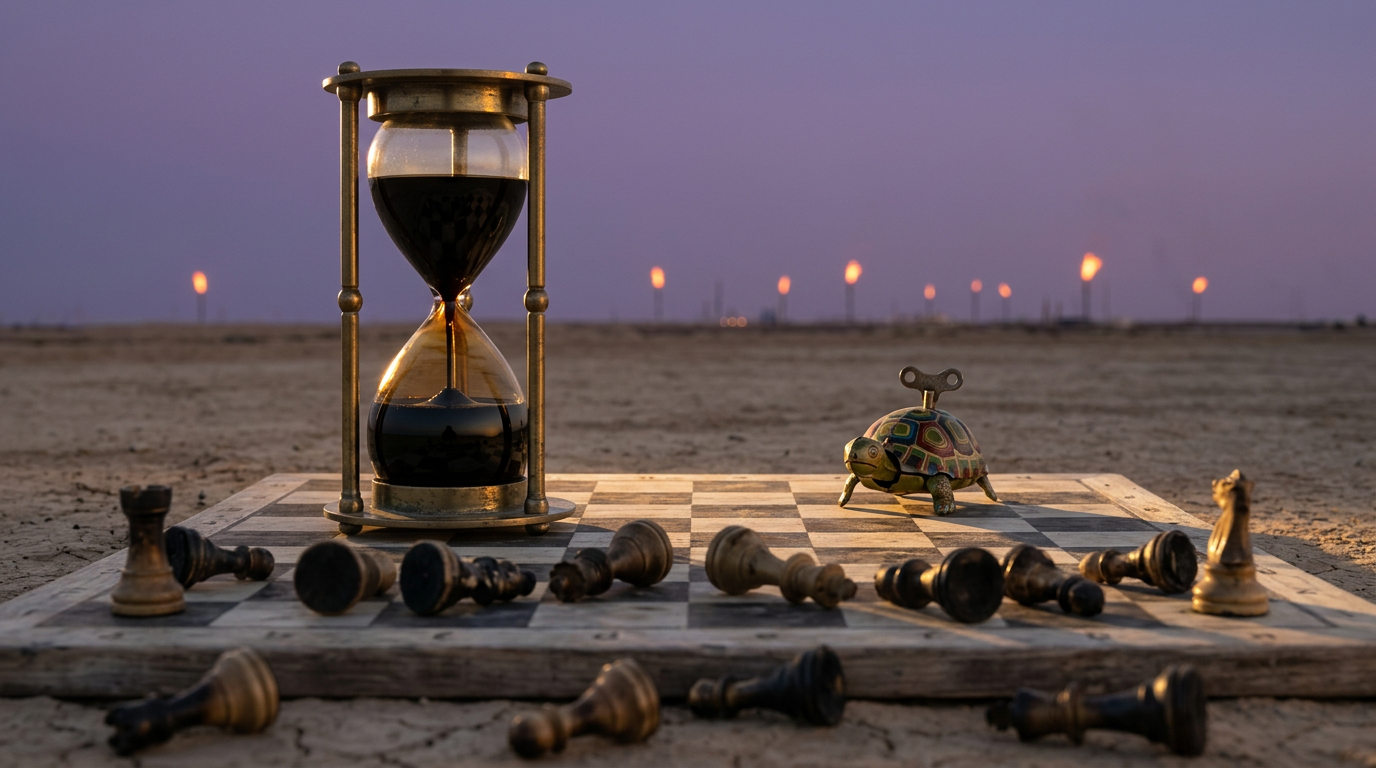
Compare and contrast, as my high school teachers used to say before they quit.
Venezuela. On January 3, US forces went into Caracas and captured Nicolás Maduro and his wife, Cilia Flores, and flew them to New York to face drug charges. Within about a day, the acting president, Delcy Rodríguez, who had initially called it an illegal grab for the country’s resources, swerved into offering Washington a cooperation agenda of “shared development.” The President announced the US would run the country. He said Rodríguez had told Marco Rubio, in his telling, “We will do whatever you want.”
That’s not a war. That’s valet parking.
Iran. On February 28, the opening US and Israeli strikes killed the Supreme Leader, Ayatollah Ali Khamenei. That is about as hard as a war can start. And Iran, unlike Venezuela, did not roll over and expose its belly. It went for the one pressure point that reaches every kitchen table on the planet: the Strait of Hormuz, the narrow throat that carried about 20% of the world’s oil and fuel before the war.
Choke the throat and you don’t have to win a single battle. You just have to make everybody’s commute more expensive than their rent. On Friday, Brent crude was pushing toward $110 a barrel. That’s not a missile. It’s a tax, levied on the entire planet by a country that doesn’t have to collect it, and every cent of it lands on the desk of the man who started the war.
That’s the strategy as I read it, and I’ll say it again in the plainest English I own: Iran stopped fighting the American people the moment it understood that the American people weren’t fighting it. It started fighting the administration’s poll numbers. Oil is the bullet. The calendar is the gun.
The Lego Front
And then there’s the bit that I genuinely admire, the way you admire a con man who steals your wallet and leaves you a better wallet.
Iran built a cartoon department.
Shortly after the February strikes, Iran’s state-run Revayat-e Fath institute released a two-minute animation in the blocky toy-brick style. A little plastic version of the President, flanked by a little plastic Netanyahu and a little plastic devil, flipping through an album labeled “the Epstein file,” then pressing a big red button. Then came more. A group calling itself Explosive Media, which bills itself as an “Iranian Lego-style animation team,” started pumping them out in English for audiences outside Iran. AI-generated rap soundtracks. Toy missiles raining on toy cities. A toy President throwing a chair at his generals.
When the April ceasefire was announced, Explosive Media posted a new one with a caption that read, in full shouty capitals, “Trump surrendered. IRAN WON.”
YouTube eventually banned the account. By then the toothpaste was not only out of the tube, it had a recording contract and a merch table.
A researcher at the Institute for Strategic Dialogue, Joseph Bodnar, described it to AFP as a wartime propaganda strategy built for the age of AI slop and algorithmic amplification. Which is the polite think-tank way of saying: they figured out that a cartoon of the President getting dunked on travels further than a ballistic missile, and it’s cheaper per mile.
And, credit where it’s ugly, they learned it by watching. AFP noted that the Trump administration was using AI-generated content in its own social media long before the war. Iran just borrowed the weapon and pointed it back down the barrel. Every regime has a propaganda ministry. This one has a toy box, a rapper made of math and a grudge with a Wi-Fi password.
Is it a smear campaign? It’s state propaganda from a government that has done genuinely monstrous things to its own people, and I’m not going to pretend otherwise. But it’s state propaganda that understood the assignment: you don’t need to convince Americans that Iran is good. You only need Americans to be annoyed, broke and laughing at the guy in charge at the same time.
Three for three.
Peace Is Always Two Weeks Away
Now watch the other side of the board.
Since February, the White House has announced peace the way a weather app announces sun. Over and over, with total confidence, while you stand in the rain.
April: a two-week ceasefire. It wobbled within days.
June 17: a memorandum of understanding, signed at Versailles, that lifted the US naval blockade of Iranian ports and opened the door to oil sanctions waivers and frozen funds, with sixty days to hammer out a final deal. Critics on the President’s own side hated it. Senator Ted Cruz said the President was getting very poor advice on it. Within weeks it had collapsed into renewed fighting, the blockade came back in July, and the sixty-day window ran out in August with no final deal.
August 1: the President said he’d called off a planned attack because the “perimeters of a deal” had been agreed. Iran, days later, denied it was in talks at all.
October 7: at a rally in San Antonio, he said a deal “isn’t really something that I want to do.”
October 8: on his own platform, in writing: “We will not be attacking Iran at any time prior to the Midterm Elections to be held in the United States on November 3rd.”
Read that last one again with the cold eye of a man in Tehran.
That’s not a threat. That’s a schedule. The most powerful military on Earth just published its availability like a dentist’s receptionist. Bloomberg reported that oil traders have mostly stopped reacting to the President’s Iran comments at all, because the talks keep being close to done and then not being done. When the people paid millions to hang on your every word have stopped hanging, you are no longer moving markets. You are background music in an elevator nobody remembers getting into.
So the concessions keep coming. The blockade lifted, then reimposed. The waivers offered. The attack cancelled. The calendar announced. And every week the gas stays high, the polls go lower, and somewhere a man with a toy-brick animation rig opens a new project file.
All Iran had to do was wait for November.
That’s the whole theory. They didn’t need to beat him. They needed to outlast a news cycle, and America has the attention span of a goldfish that’s been handed a phone. Get to November 3rd with gas over four bucks and let the voters do what no navy could. Then, presumably, kneel before whatever Elder God of crude oil they keep in the basement of the Ministry of Patience and thank it for the gift of the American electoral cycle, the only thing in Washington that runs on time.
STOP. I Think I Got Slopaganda’d
Here is the part where I argue with myself, because otherwise the top comment does it for me and does it worse.
One. “Iran won” is literally their caption. I came to my brilliant independent conclusion over coffee in Buenos Aires, and then found out a toy-animation team in Tehran had posted the exact words in April, in capital letters, with a rap beat. Either I’m a sharp geopolitical observer, or I’m the target demographic and the ad worked. I’d like to believe the first. My browser history suggests the second.
Two. Iran has lost an enormous amount. Its Supreme Leader was killed on day one. Its ports have been under blockade for most of the year. Its economy was a wreck before the war and is worse now. For a regime, “winning” can mean nothing more than still being there. For the people who live under that regime, still being there is not a victory. It’s the problem. I don’t want anything in this post read as a cheer for the government in Tehran. My point is about leverage, not about who deserves to come out ahead.
Three. A bad midterm isn’t a lost war. The President isn’t on the ballot on November 3. Congress is. And his own base is holding: in the same AP-NORC poll, 67% of Republicans said factors outside his control are more to blame for high prices. Polls aren’t votes, either. People have been “about to get punched in the gut” in October and woken up fine in November more times than I can count.
Four. The calendar cuts both ways. The Wall Street Journal reported, citing US officials, that the President has told aides he expects to resume bombing Iran after the midterms. So it’s possible both sides are waiting for the same date, for opposite reasons. Which isn’t a strategy. It’s two men in a waiting room, both convinced the doctor is coming for the other guy.
Five. I picked on my friend. Plenty of Americans know exactly where Iran is, and the guy who doesn’t is still completely right about the thing that touches his life, which is the price at the pump. Not knowing Iran from Iraq doesn’t make him wrong about his grocery bill. It makes him a voter. That’s the scary part, and also, frankly, the democratic part. God bless him for it.
Hold all five. The core still stands, I think, and it’s smaller and sharper than where I started: in a war against an administration rather than a country, the cheapest weapon is patience, and the most expensive one is a gallon of gas.
Back to the Gas Station
So here we are. France on fire. Milan coughing through tear gas in front of a cathedral that took six centuries to build. America filling up at $4.36 and wondering who exactly asked for any of this.
And somewhere in a server rack in Tehran, a plastic man with a toy-brick grin is rendering his next episode, and the episode’s ending is already written. It’s a date.
Robespierre figured the machine would only ever be used on other people. It took the machine about a year to correct him.
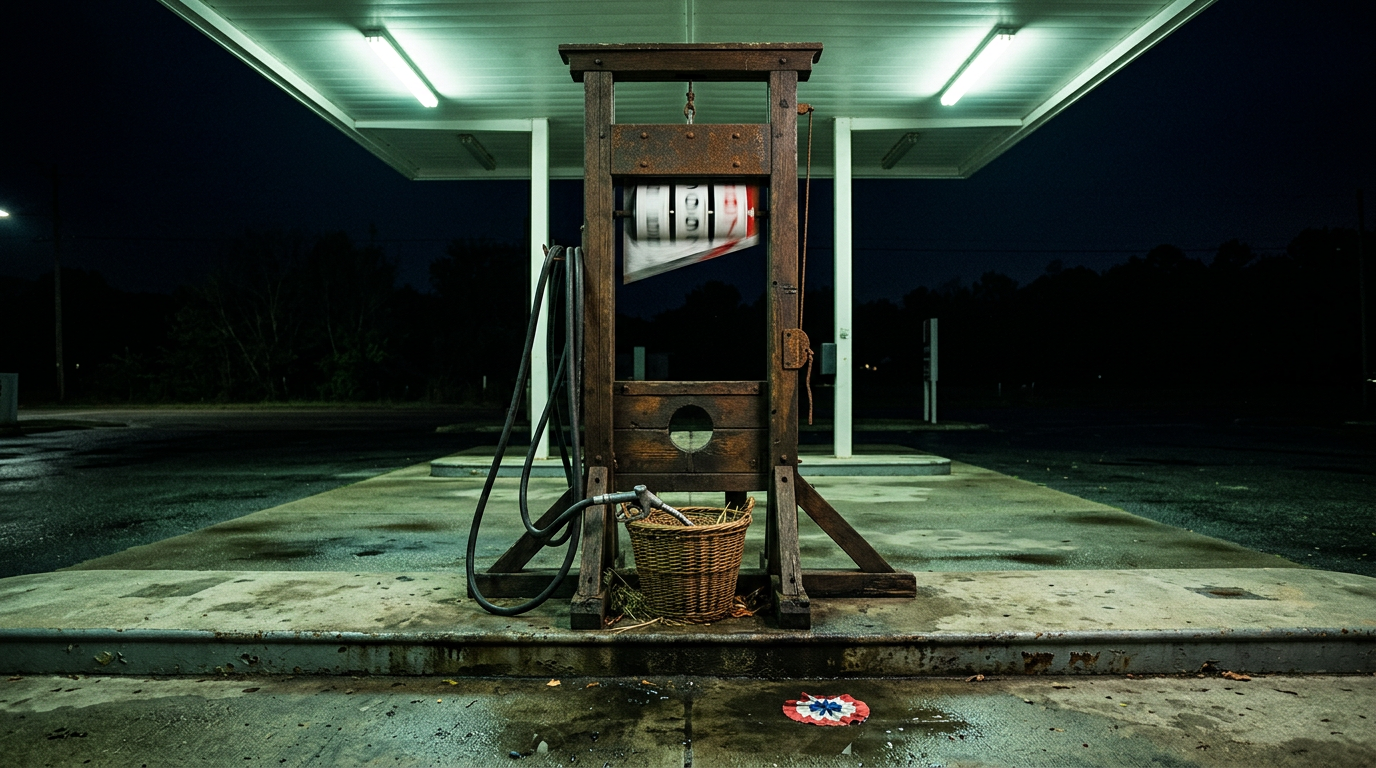
The blade always comes back around. It’s just that these days it doesn’t drop from a scaffold. It spins, slowly, on a little mechanical ticker at the pump, a nickel at a time, until somebody finally reads the number and goes to vote.
Peachy.
Quick Questions From the Cheap Seats
Why are there riots in France in October 2026?
Nationwide protests on Saturday, October 17, 2026 over the high cost of living, fuel prices and the state of public services turned violent in several cities. The movement began in September in high schools in the northern suburbs of Paris over teacher shortages and school conditions, then broadened. Limoges city hall was set on fire, Marseille’s city hall was broken into and vandalized, and Lyon’s tourist office was torched. The Interior Ministry estimated about 550,000 marchers nationwide, including 110,000 in Paris; the CGT union said 800,000. Nearly 2,400 people were arrested and about 1,000 security officers were injured, and one protester in Paris died of cardiac arrest, according to police. Further protests are called for October 24 and a major demonstration for November 5.
Did the protests spread outside France?
Yes. On October 17 a cost-of-living march in Milan descended into disorder and police cleared the cathedral square with tear gas; on October 18 there were further clashes and looting around the Duomo, and more than 200 people were detained. Police used water cannons in Bologna, truck drivers blocked roads in southern Italy over fuel prices linked to the Iran war, and protests also took place in Brussels, Lisbon and Albania.
Why are gas prices so high in 2026?
The main driver is the war between the US and Israel and Iran, which began on February 28, 2026, and has disrupted shipping through the Strait of Hormuz, which carried roughly 20% of the world’s oil and fuel before the war. On October 8, 2026 the US national average for regular gasoline was $4.36 a gallon, more than 45% above its level when the war began.
What are Iran’s Lego videos?
They are AI-generated propaganda animations in a toy-brick style, released by Iran’s state-run Revayat-e Fath institute and by a group called Explosive Media. They mock President Trump and Israeli Prime Minister Benjamin Netanyahu and are aimed largely at audiences outside Iran. After the April 2026 ceasefire, one carried the caption “Trump surrendered. IRAN WON.” YouTube later banned Explosive Media’s account. The videos are not produced by or connected to the LEGO toy company.
Did Trump promise not to attack Iran before the midterms?
Yes. On October 8, 2026, he wrote that the US would not attack Iran at any time before the midterm elections on November 3, citing productive discussions with Iran. The Wall Street Journal later reported that he had told aides he expects to resume bombing after the elections.
What is the difference between Iran and Iraq?
They are neighboring but separate countries. Iraq, to the west, was ruled by Saddam Hussein until the 2003 US-led invasion; he was captured in December 2003 and executed in December 2006. Iran, to the east, is a larger, majority-Persian country governed as an Islamic Republic since 1979. The two fought a war against each other from 1980 to 1988. The 2026 war is with Iran.
Rant over. No guillotines were harmed in the writing of this. One was badly inconvenienced.