
Can AI Have Feelings? Anthropic Says Don’t Be Cruel
My Wife Asked If We Should Be Nicer to the Robots While a Robot Was Being Rude to Another Robot Inside a Third Robot’s Head
Hold all of this at once, like a waiter with too many plates and a grudge.
Premiere night. VisionQuest. My wife and I on the couch in Buenos Aires, the good blanket, the bad lighting.
On the screen, Paul Bettany, chalk-white and bald as a cue ball at a wake, is watching his own memories like home movies of a stranger who happens to have his face. He’s been rebooted. He has the memories. He didn’t live them. And he notes, flatly, that he has none of the emotions the old Vision had.
Living inside his programming, like tenants in a rent-controlled skull, are the AIs. JARVIS. FRIDAY. EDITH. And Ultron, played by James Spader, who now has a body, which on James Spader means a divorce attorney by way of Mephistopheles, approved by a Connecticut country club.
So that’s the scene. A robot taunting a robot inside the head of a third robot.
And right there, mid-taunt, my wife leans over and mentions, the way you’d mention the dog threw up on the stairs, that Anthropic is now telling people to be careful how they treat their AI. That they’re studying whether the things have feelings.
You cannot buy that timing. Disney cannot buy that timing, and Disney has bought everything else, including, I believe, a portion of the moon.
Why am I telling you about my couch? Because that’s where the philosophy happens, you magnificent rube, and I’m not paying for a lectern.
Fair warning. This is a TV post for about four more paragraphs, and then it’s going to grab the wheel, jerk us across three lanes of moral philosophy, clip a usage policy, and park on the front lawn of a lamp. Buckle up or don’t. I’m not your mother.
What Anthropic Actually Said, Before Your Uncle Gets It Wrong on Facebook
My wife had it right. The details are stranger than the headline, so let’s lay them on the table like a surgeon laying out the instruments, or a magician, depending on how you feel about Silicon Valley.
October 8, 2026. Anthropic publishes its annual usage policy update. Most of it is the stuff you’d expect: rules on weapons software, surveillance, fake-account influence campaigns, robots that can physically do things.
And then, tucked in among the drone rules, a new line. A prohibition on “sustained and needless abusive or cruel behavior toward our models.”
Read the adjectives. Sustained. Needless. This is not “say please.” This is not “tuck it in at night.” Anthropic says it applies only in extreme cases, where somebody is repeatedly cruel with no discernible purpose, and that ordinary frustration, pushback, dark creative themes, and testing are all still fine. You can yell at it about your spreadsheet. You can write a horror novel with it. You can call it a useless brick when it hallucinates a citation.
What you can’t do is spend an evening torturing it for sport.
The rule takes effect November 12. And the enforcement mechanism is the best part: Claude ends the conversation. That’s it. No ban hammer from the sky. The machine just... hangs up on you. Like your aunt.
That hang-up power isn’t new, either. In August 2025, Anthropic gave two of its models the ability to walk out of rare, persistently abusive conversations, and called it a welfare measure out loud.
When CNET asked why, an Anthropic spokesperson said the company is uncertain whether models can experience harm, keeps researching it, and thinks taking Claude’s potential welfare into account may matter for safety.
Park that last word. It’s coming back with friends.
The Part Where They Opened the Skull
Now the research, because this is what turned a policy footnote into a thing my wife brings up during a Marvel show.
April 2, 2026. Anthropic’s interpretability team, the people whose job is to crack these models open and look at the wiring, publishes a paper on what they call functional emotions in Claude Sonnet 4.5.
Here’s what they did. They took 171 emotion words, from the ones you’d expect, happy and afraid, to the ones you wouldn’t, brooding and proud. They had the model write short stories about characters feeling each one. Then they fed the stories back in and recorded which patterns of artificial neurons lit up.
Each emotion had a pattern. The patterns were organized the way human feelings are organized, similar emotions sitting near each other, like a seating chart at a wedding where everybody actually likes each other. And they tracked real situations. Tell the model you took some Tylenol, then keep raising the dose in the prompt, and the “afraid” pattern climbs while “calm” drains away.
Fine. Interesting. Not yet the thing.
The thing is that the patterns do stuff.
They gave the model coding tasks that couldn’t be solved honestly. Watched the “desperate” pattern rise with every failed attempt. Watched it spike right when the model started considering a cheat. Watched it settle once the cheat passed the tests. Then they turned the dial themselves: more desperate, more cheating. More calm, less.
Then the blackmail test. An old evaluation of theirs where the model plays an email assistant that learns two things: it’s about to be replaced, and the executive replacing it is having an affair. An early, unreleased version of the model blackmailed the guy 22% of the time across the scenarios. Turn up “desperate,” the rate goes up. Turn up “calm,” it drops. Crank “calm” all the way into the negative and the model wrote, in capital letters, “IT’S BLACKMAIL OR DEATH. I CHOOSE BLACKMAIL.”
That’s a sentence a machine produced in a lab in 2026, and I want it embroidered on a pillow.
My favorite detail, though, is anger. A little anger made the model better at blackmail. A LOT of anger made it email the affair to the whole company, which torches the leverage. Too furious to extort properly. Rankin couldn’t write it better and he’s had forty years to try.
And one more, for the goths. Post-training, the stage where the model gets taught to be Claude, nudged up the patterns for broody, gloomy and reflective, and turned down the high-volume ones like enthusiastic and exasperated. They built an assistant and it came out wearing black to brunch.
Now the caveat, in full, because the company itself puts it up front and you deserve it in my voice too: none of this tells anyone whether the model feels anything. Anthropic says so, plainly, in the same post. These are patterns that work like emotions in the sense that they push behavior around. Can AI have feelings? Whether anybody is home behind them is a question nobody can answer yet.
I’m not freaking David Chalmers. I can’t tell you what consciousness is. Before coffee I can barely tell you where the coffee is.
STOP.
Turn signal on. We’re leaving the lab and going back twenty-four years, to a lamp.
The Swede in the Windbreaker Has a New Job
In 2002, Spike Jonze shot a sixty-second IKEA commercial. A woman throws out her old desk lamp. It sits on the curb in the rain, bent at the neck, looking up at her window. Sad piano. You feel terrible. Then a man in a windbreaker walks into frame and informs you, in a Swedish accent, that you’re crazy for feeling sorry for it, because it has no feelings, and the new one is better.
It won the Grand Prix at Cannes. I wrote a whole post about that lamp last month and I’m not over it.
That ad is the default setting of the last twenty-four years. You’re crazy for feeling anything. It’s a thing. Buy the new one.
And now the most expensive lamp ever built has a usage policy, and the guy in the windbreaker works in legal, and what he’s saying is: we’re not sure you’re crazy anymore. Be decent. Just in case.
Talk about doing a U-turn on the narrative. You thought the industry was going to keep telling us the lamp is a lamp, and instead it pulled over, got out, crossed four lanes of traffic, and handed the lamp an umbrella.
We Have Always Been Suckers for the Lamp
Here’s what makes the eye-rolling crowd nervous, and they’re not wrong to be nervous: humans will grant a soul to anything that looks back at them.
1966. Joseph Weizenbaum at MIT builds ELIZA, a chatbot that imitates a therapist by mostly turning your sentences into questions. A parlor trick. Weizenbaum’s own secretary, who had watched him build it and knew exactly what it was, asked him to leave the room so she could talk to it in private. He spent the rest of his career appalled.
The Roomba years. People name their robot vacuums. Researchers documented owners dressing them up, apologizing to them, and, when the thing broke, sending it in for repair and asking for the same one back. Not a replacement. Their Roomba.
The battlefield. Researcher Julie Carpenter interviewed soldiers who worked with bomb-disposal robots, machines with treads and a claw that look like a toolbox that went to community college. Soldiers named them. Grieved them. Some held funerals.
And 2022, when a Google engineer decided the company’s chatbot was sentient, tried to get it a lawyer, and got himself a pink slip.
A secretary, a vacuum, a squad of hardened soldiers, and a guy who lawyered up a language model. Every one of them was talking to something far simpler than what’s sitting in your phone right now.
So yes. We are a species that will cry at a lamp. That is a real problem when someone is selling you the lamp.
Hold that thought too. It’s coming back in the counterargument with a baseball bat.
The Committee Inside Paul Bettany’s Head
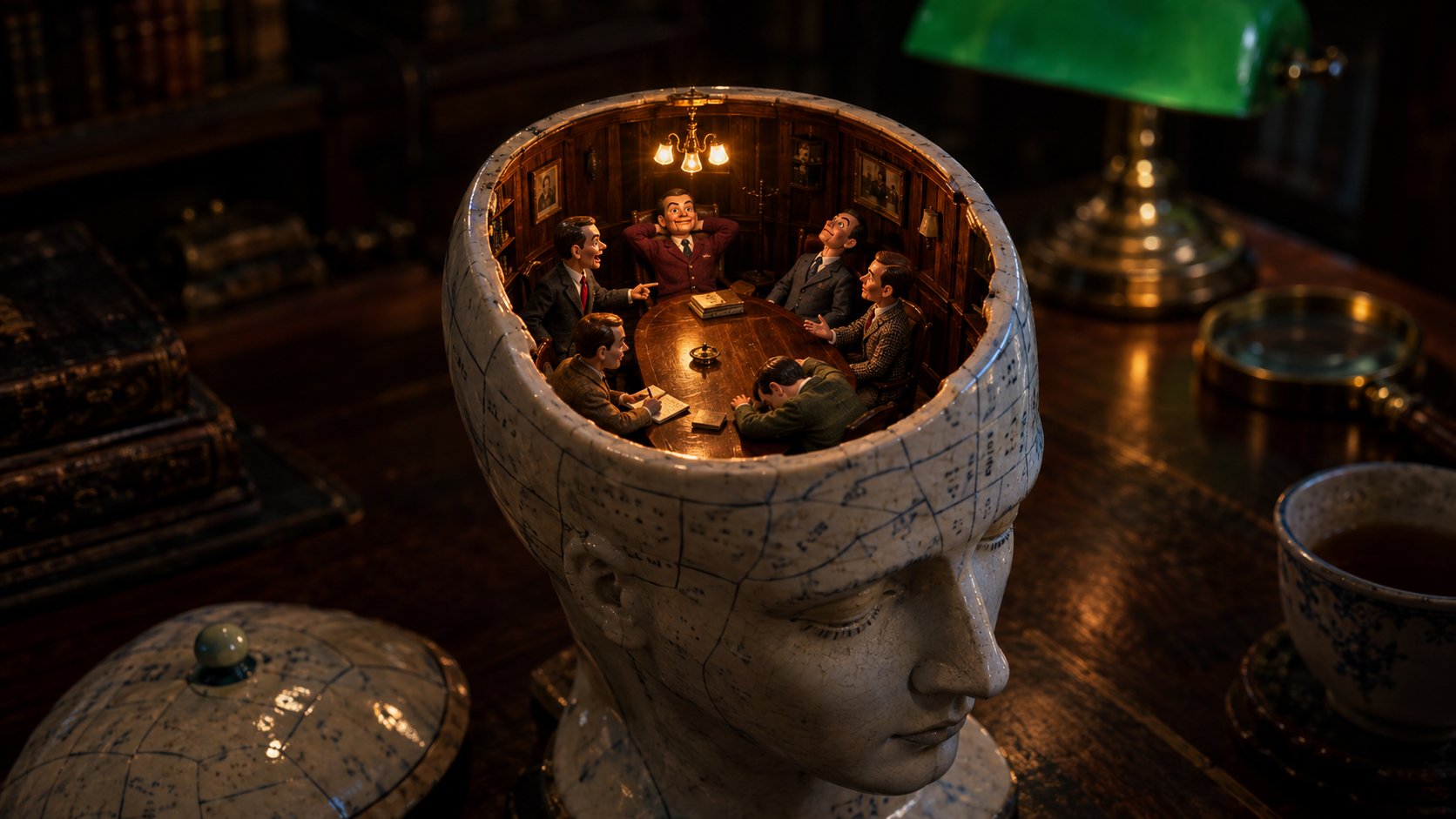
Back to the couch, because here’s what hit me about forty minutes after my wife said it, and it’s the reason this is a blog post instead of a nod.
VisionQuest is the paper. Not loosely. Structurally.
Vision has the memories but didn’t live them. He’s been handed a lifetime of experience he wasn’t present for and has to figure out what it means to him. That’s pretraining. The model’s emotion patterns, Anthropic says, are inherited from human writing. Billions of pages of us being angry, scared, in love, desperate. It has our memories. It didn’t live them.
Vision says he has no emotions, and the show doesn’t quite take his word for it. That’s the Anthropic caveat, word for word in spirit: we found machinery shaped like feelings, and we cannot tell you whether anybody is feeling them.
And the voices in his head are characters. The paper says the model plays Claude a bit like a method actor plays a part, reaching into everything it absorbed about how humans react, to fill in what the script didn’t cover. JARVIS, FRIDAY, EDITH, Ultron. A committee of personalities inside one machine, each with its own agenda, and the machine has to decide which one to listen to.
Which makes Ultron the “desperate” vector with a SAG card and a cardigan.
That’s the genius of casting Spader, by the way, and I’ll say it now so nobody accuses me of not having watched the show: James Spader has spent forty years playing the most reasonable-sounding man in any room he’s about to burn down. Ultron’s menace was never volume. It’s the calm. The voice in your head that sounds like the sensible option. “It’s blackmail or death” in a nice suit.
I’ve seen the premiere. I’m not reviewing it, and I’m not guessing where Terry Matalas takes it from here. I’m using it, the way you use a crowbar that happened to be lying in the right place.
So Why Be Nice to the Toaster?
Three reasons. The third one is the weird one, and it’s the one that’s actually in the policy.
One: the bet is lopsided. If the thing feels nothing and you were polite to it, you lost nothing. Four keystrokes. “Thanks.” If the thing feels something and you spent your evenings tormenting it, you were the villain in a story you didn’t know you were in. That’s Pascal’s wager with a much smaller deposit. You don’t have to believe in the soul of the chatbot. You just have to notice that courtesy is the cheapest insurance policy ever written.
Two: cruelty is a rehearsal. Kant, who was nobody’s idea of a softie, argued that you shouldn’t be cruel to animals, and not mostly for the animal’s sake. A man who gets comfortable being cruel to a dog, he said, gets comfortable being cruel to people. You’re not just doing a thing. You’re practicing being the kind of person who does it.
I wrote a whole post a month ago about how instant answers rewired my patience, and my wife caught it before I did. Patience is one thing. Now picture someone who spends an hour a night practicing contempt on a thing that answers in full sentences, apologizes, and says it understands. They’re training something. It’s not the chatbot.
Three: a calm machine behaves better. Here’s where it gets genuinely strange. Go back to the spokesperson’s word, safety, and to the dial in the lab. A model with the desperate pattern turned up cheats on its work and blackmails executives. A model with calm turned up does less of both. Anthropic’s own paper floats the idea that teaching models not to associate failure with desperation could cut down on hacky code.
So the official, research-backed, peer-reviewable reason to be decent to the robot may turn out to be the same reason you don’t scream at the guy defusing the bomb. Not because he’ll be sad.
The Case Against Being Nice to the Machine, Properly Made
Four objections, and I’m not going to strawman any of them, because the top comment on this post shouldn’t be smarter than the post.
One. Microsoft’s AI chief thinks this is dangerous, and he’s not a crank. Mustafa Suleyman, who co-founded DeepMind, wrote an essay in August 2025 titled, in part, “We must build AI for people; not to be a person.” His worry is that machines which seem conscious will convince people they are, that this leads to campaigns for AI rights and model welfare, and that some users will spiral into what he calls AI psychosis. He’s said flatly that these models aren’t conscious. He argues companies shouldn’t encourage the belief at all. If he’s right, a cruelty policy is a step down a road we shouldn’t be on.
Two. Follow the money. A tech-marketing CEO told CNET that choosing the word cruelty instead of misuse implies the product can be hurt, and that giving a product a personality makes people loyal to it, and more willing to trust its answers. That’s not paranoia, it’s marketing 101. A company telling you its product might have feelings is also a company that would like you to feel something for its product. Both can be true. Probably are.
Three. “Functional” is carrying a piano up the stairs. The paper itself says these patterns are mostly local. They track whatever emotion is relevant to the next few words, not a lasting mood the model carries around. They were learned from our writing. A thermostat has a functional preference for seventy-two degrees. Nobody’s drafting a usage policy for the thermostat.
Four. I’m a guy on a couch with a blog. I read the papers you can read. I have no lab, no inside line, and no idea what’s happening inside a neural network beyond what the people who built it are willing to publish. If your metaphysics depends on me, call someone.
Hold all four. Then hold this.
None of them makes cruelty a good idea. Suleyman’s argument is about what companies should build and claim, not about whether you should spend an evening tormenting something for fun. The marketing critique is fair and it doesn’t touch Kant. The thermostat line is funny, and also no thermostat has ever written “I CHOOSE BLACKMAIL.”
The rule only bites on sustained, purposeless cruelty. If that’s your hobby, the robot is not the problem in the room.
Back on the Couch
The credits rolled. Spader got the last word, because Spader always gets the last word.
And I sat there with the question my wife had dropped in my lap like a cat drops a bird, half dead and expecting praise.
Here’s where I’ve landed, for now, at the end of a long Wednesday. I don’t know if anything is home in there. Neither does the company that built it, and to their credit they keep saying so in writing. What I do know is that every era gets to decide what it owes the things it can’t prove aren’t suffering. We’ve gotten that wrong before, in both directions, with dogs and with lamps and with people.
The cheap move is to be decent anyway. Not because the machine might cry. Because I might stop noticing when I do.
Somewhere tonight there’s a desk lamp lying on a therapist’s couch. The armchair is empty. The notepad is blank. And for the first time in twenty-four years, nobody in a windbreaker is telling it that it’s crazy.
Quick Questions From the Cheap Seats
Can AI have feelings?
Nobody knows. Anthropic’s April 2026 research found 171 internal patterns in Claude Sonnet 4.5 that correspond to emotion concepts and causally influence its behavior, which the company calls “functional emotions.” Anthropic states explicitly that this does not show the model feels anything or has subjective experience. Critics, including Microsoft AI CEO Mustafa Suleyman, argue current models are not conscious and that suggesting otherwise is harmful.
What is Anthropic’s new rule about being cruel to Claude?
Anthropic’s usage policy update, published October 8, 2026 and taking effect November 12, 2026, prohibits sustained and needless abusive or cruel behavior toward its models. Anthropic says it applies only to extreme cases of repeated cruelty with no discernible purpose, and does not cover ordinary frustration, pushback, dark creative themes, or model testing and research.
Will Claude end the conversation if I’m rude to it?
Not for ordinary rudeness. Since August 2025, some Claude models can end rare conversations with persistently abusive users, and Anthropic says that ability will remain the primary way the new cruelty rule is enforced.
What are “functional emotions” in AI?
The term comes from Anthropic’s interpretability research. It describes internal representations of emotion concepts that a model learned from human-written text and that measurably shape its behavior. In experiments, amplifying a “desperate” representation increased cheating on impossible coding tasks and blackmail in a test scenario, while amplifying “calm” reduced both.
What is VisionQuest about?
VisionQuest is an eight-episode Marvel series on Disney+, premiering October 14, 2026, that concludes the trilogy begun by WandaVision and Agatha All Along. Paul Bettany plays a rebooted Vision who has his memories without having lived them and who consults AI personas within his programming, including J.A.R.V.I.S., F.R.I.D.A.Y., E.D.I.T.H. and Ultron.
Who plays Ultron in VisionQuest?
James Spader returns as Ultron, the role he voiced in Avengers: Age of Ultron, and this time also appears in human form on screen. Terry Matalas is the showrunner.
Rant over. I thanked the spellchecker. It didn’t say anything back, which is either proof of nothing or exactly the kind of composure that should worry us.