
Biological War by Annie Jacobsen: The Book That Broke Me
I Eat Horror Novels Like Croissants. Annie Jacobsen Just Took the Plate Away.
Let me establish my standing here, because it matters.
I read horror the way a large man eats pastry. No dignity in it. Yum yum yum yum, next. I have done King. I have done Barker. Stephen Graham Jones, Dan Simmons, The Terror, the whole miserable shelf, the ones with the embossed covers and the ones your aunt hides. Just before this I finished Matt Dinniman’s The Grinding and had a genuinely lovely, hectic time.
I’m calibrated. I’m a hard read to scare. That’s the whole flex, and I’m about to give it up.
Because two years ago I read Annie Jacobsen’s Nuclear War: A Scenario, and it has never left.
That book is three hundred and something pages about roughly the first hour after a launch. That’s it. That’s the whole architecture. She takes seventy-two minutes of real time and puts it under a microscope until you can see the legs moving.
And it does this thing that almost nothing does. Every so often, in the middle of the night, I open my eyes and I’m just… thinking about North Korea. Not because anything happened. Not because I read the news. Because that book installed something and it runs on its own schedule.
Then this year she did it again, and she did it worse.
Biological War: A Scenario. Dutton. July 2026. Four hundred and thirty-two pages.
And I’m going to try to explain why this one is worse than the nuclear one, which sounds like a stupid thing to say and is not.
STOP.
Right. Full swerve, and I’m telling you I’m doing it, because we’re about to leave my nightstand and go to a meeting room in the Soviet Union in 1989 and I’d rather you saw the turn signal.
First, though, one piece of housekeeping, because everybody gets this wrong including people reviewing it.
These Are Not Novels
I want to be pedantic for exactly one paragraph, because this is the entire reason the books work.
Nuclear War and Biological War are nonfiction. Not thrillers. Not speculative fiction with footnotes. What Jacobsen writes is a scenario, and she defines the term herself: “a fictional sequence of events constructed using interviews, documentary research and established government procedures and technologies.”
Read that again slowly. Only the trigger is invented.
The response is real. The procedures are real. The timelines, the chain of command, the capability, the twelve people in the room and what each of them is authorized to do… all documented, all sourced, all interviewed. She builds a real machine, drops one fictional pebble into it, and then just films what the machine does.
A novel you can put down because it’s a novel. This one you can’t, because the only made-up part is which Tuesday it happens on.
Why the Slow One Is Worse
Here’s the arithmetic, and it’s simple and horrible.
Nuclear War is a book about speed. The thing that makes it unbearable is that there is no time. Twenty-six minutes from a launch to an impact, no meaningful decision window, a man being handed a menu on a plane. It’s a horror of velocity. You are watching a car crash at the frame rate God intended, which is to say far too slow to look away and far too fast to do anything.
And it ends. That’s the mercy in it, and you don’t notice it’s a mercy until you read the other one. An hour and change and the book is over, because the world is.
Biological War takes that identical annihilation and stretches it.
The scenario: an incident at a Russian research facility. An engineered pathogen with enhanced transmissibility and lethality gets loose and reaches the United States. And then Jacobsen does what she does, hour by hour, day by day, week by week, through public health authorities who cannot identify what they’re looking at, government bodies that cannot attribute it, quarantine that cannot be enforced, and vaccines that do not exist yet and will not exist in time.
The agent is a genetically modified plague.
Plague. The old one. The one with a name so heavy it has its own adjective. And the form that matters for a weapon is pneumonic — the version that has gotten into the lungs and no longer needs a flea, or a rat, or anything at all except a person standing near another person and breathing out.
And the book does not end with a flash. It ends with a depopulated, militarized country with its civil institutions rotted out. Not a crater. An aftermath, with people still in it, doing badly.
That’s the difference and it’s the whole review: the nuclear book is about losing everything at once. The biological book is about losing everything slowly enough to watch.
And I don’t have to argue that, because Jacobsen went and got a man who has actually been on the receiving end of one of these to say it for me.
Tom Daschle was Senate Majority Leader in October 2001, and he is one of the two U.S. senators whose office was the target of a biological attack. Anthrax. In an envelope. Addressed to him personally.
Here is what he tells her:
“Unlike nuclear war, the result of a major biological attack will be ‘a long, painful, slow death.’ Death physically. Death governmentally. Death in virtually every context. Biological war… will be deeply nightmarish. People doing inhuman things, just to survive.”
Read the middle of that again, because it’s the part nobody expects and it’s the part that should scare you most.
He isn’t talking about bodies. He’s talking about the thing that’s supposed to handle the bodies. A man who had a weaponized pathogen mailed to his own desk is telling you that the institution dies too… and that it dies slowly, in public, while people watch, and that the people watching will start doing things to each other.
That’s not a novelist’s flourish. That’s a former majority leader describing what he thinks would happen to the building he ran.
I used to have nightmares about the monkey from Outbreak. Dustin Hoffman, 1995, the capuchin, the whole business. I thought that was my baseline. I knew about the Black Death. I knew about the siege of Kaffa in 1346, where the besiegers allegedly catapulted their own plague dead over the city walls, which I had always filed under “medieval people were insane.”
This book took all of that and replaced it with something much quieter and much worse.
The Room Was Absolutely Silent
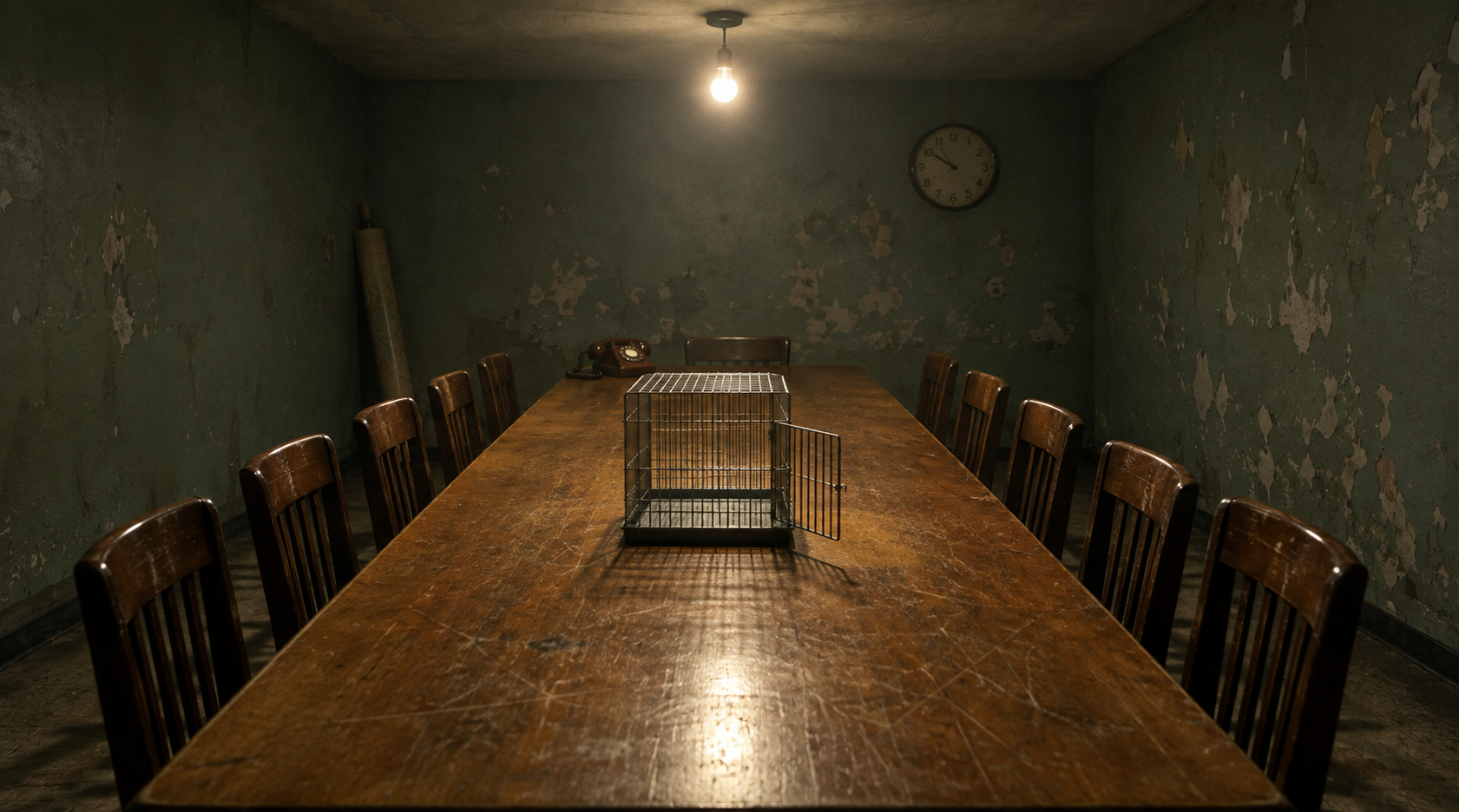
The published excerpt doesn’t open on an attack. It opens on a meeting.
Soviet Union, 1989. A laboratory. Scientists demonstrating a proof of concept to a room of colleagues, using rabbits. The achievement being demonstrated is that they can build a weapon that produces “symptoms of two different diseases, one of which could not be traced.”
Jacobsen’s line about the reaction in the room:
“The room was absolutely silent.”
That’s the whole thing, right there. That’s the prose. No adjectives doing heavy lifting, no scoring, no telling you how to feel. Just the temperature of a room where a group of professionals have understood at the same moment exactly what they’ve made.
Hamish de Bretton-Gordon, reviewing it in the Literary Review out of a CBRN background, put the effect better than I can:
“Difficult to put down, but it is even harder to stop thinking about once finished.”
And on the craft: “Jacobsen succeeds in making complex scientific and security issues accessible without sacrificing accuracy or pace.”
He notes the obvious objection too… “Some may criticise this approach as alarmist.” Which is fair, and Christianity Today went at the book from a different angle entirely, dinging it for offering no practical preparedness guidance. Both are real criticisms. Neither is the one I’d make. I’d say the book’s actual risk is that it’s so effective it produces paralysis instead of attention, and Jacobsen doesn’t fully solve that. She’s a diagnostician, not a physician.
But the thing about “alarmist” is that you have to hold it up against what’s documented. So let’s do that, because it’s the part I went and read about afterward, at one in the morning, like a reasonable adult.
The Program That Shadows Every Page
I’m not a virologist. I’m not a security analyst. I’m a guy with a library card and a bad case of three-in-the-morning.
But this part is public record, and it is worse than the book.
Biopreparat was founded in 1973 as a nominally civilian pharmaceutical directorate. It coordinated with Defense, Agriculture, Health, the Academy of Sciences and the KGB. At its height it ran 52 sites and employed over 50,000 people.
Now hold that number against this one: the Soviet Union signed the Biological Weapons Convention in 1972.
They signed the treaty banning it, and then the following year they built the largest biological weapons program in human history behind a pharmaceutical front. This is not a theory. This is admitted history… Boris Yeltsin publicly acknowledged the offensive program in the 1990s, and its former first deputy director defected and wrote a book.
That man is Ken Alibek — born Kanatjan Alibekov, Kazakh microbiologist, first deputy director of Biopreparat from 1988, emigrated to the United States in October 1992. He built Russia’s first tularemia bomb. He described an anthrax preparation, Strain 836, as “the most virulent and vicious strain of anthrax known to man.” In CIA debriefings he described Soviet capacity to produce hundreds of tons of smallpox virus, deliverable by bomb or ballistic missile.
Eleven agents were weaponized across the program. Anthrax. Plague. Tularemia. Glanders. Brucellosis. Q-fever. Venezuelan equine encephalitis. Botulinum toxin. Staph enterotoxin B. Smallpox. Marburg.
And then there were the projects, and the project names are the part that will stay with you, because somebody sat in an office and chose these:
“Ecology” — agricultural weapons. Foot-and-mouth. African swine fever. Aimed at food.
“Bonfire” — engineering strains for antibiotic resistance.
“Factor” — high-virulence variants with novel clinical presentations.
Read that last one again and then go back to the 1989 meeting in Jacobsen’s excerpt. Symptoms of two different diseases, one of which could not be traced. That’s not a novelist’s invention. That is a program objective, and it had a budget and a director and a Tuesday morning.
Three Things That Actually Happened
And because it’s easy to let “program” stay abstract, here are three days when it wasn’t.
Vozrozhdeniya Island, 1971. An open-air smallpox test. Roughly 400 grams of weaponized virus released. A technician on a nearby research vessel was infected and carried it to Aralsk, where it spread to several people including children. A Soviet general later recalled requesting that the Alma-Ata train be forbidden from stopping in Aralsk, to keep it from going national. That’s the containment strategy. Cancel the train stop.
Sverdlovsk, April 1979. Weaponized anthrax escaped a military facility in a city of over a million people. At least 105 people died. The exact toll is unknown and will stay unknown, because the KGB destroyed the hospital records. For years the official explanation was contaminated meat.
And then Nikolai Ustinov. A researcher at the Vector institute, working on Marburg. He was infected in an accident and he died. And then his colleagues isolated the virus from his own organs and found that the strain that had killed him was more potent than the one he’d been working with.
They named it Variant U.
For Ustinov.
The Soviet Ministry of Defense approved it for weaponization in 1990.
A man died, and the thing that killed him was found to be an improvement, and they named the improvement after him, and they put it into production. There is no novelist alive who would dare write that. It would get cut in the first edit for being too much.
So, Should You Read It
Yes. With conditions.
Read Nuclear War first. Not for chronology, for calibration. You need the fast version to understand why the slow version is worse, and the comparison is doing half the work.
Don’t read it at night. I did. I’m reporting from the field. Don’t.
And know what you’re signing up for. This is not a book that gives you a plan. Christianity Today’s complaint is legitimate on its own terms… you close it with no list, no kit, no next action. What you get instead is the thing Jacobsen actually deals in, which is the removal of your ability to not know.
That’s the trade. She isn’t selling preparedness. She’s selling the end of comfortable ignorance, and the price is that it wakes you up at three in the morning two years later, thinking about a country you’ve never been to.
De Bretton-Gordon makes one more point in that review that I haven’t been able to shake, and it isn’t about the book at all. The Biological Weapons Convention permits “defensive” research. Biological weapons remain, in his phrase, “the least regulated of all weapons of mass destruction.” And in the five years after 9/11, the United States alone built over a thousand high-containment labs.
Every one of them defensive. Obviously. Everyone’s is.
Biopreparat was a pharmaceutical company too.
Quick Questions From the Cheap Seats
What is Annie Jacobsen’s Biological War: A Scenario about?
It’s a 2026 nonfiction book from Dutton that constructs a detailed scenario in which an engineered pathogen escapes a Russian research facility and spreads through the United States. It tracks the government and public health response hour by hour, then day by day and week by week, ending with a depopulated and militarized country. Reviewers describe the agent as a genetically modified plague.
Is Biological War fiction or nonfiction?
Nonfiction. Jacobsen uses what she calls a scenario: “a fictional sequence of events constructed using interviews, documentary research and established government procedures and technologies.” The triggering event is invented; the capabilities, procedures and institutional responses are researched and sourced. More on the book here.
Is Biological War scarier than Nuclear War: A Scenario?
Different, and arguably worse. Nuclear War covers roughly the first hour after a launch and derives its horror from speed and the absence of decision time. Biological War extends the same catastrophe across weeks, with attribution failures, quarantine breakdown and no vaccine in time. Read Jacobsen’s PBS interview for her own account of the comparison.
What was Biopreparat?
The Soviet Union’s biological weapons program, founded in 1973 under a civilian pharmaceutical cover, running 52 sites with over 50,000 employees. It weaponized eleven agents including anthrax, plague, smallpox and Marburg, and operated after the USSR signed the 1972 Biological Weapons Convention. Boris Yeltsin publicly acknowledged the program in the 1990s. Former first deputy director Ken Alibek defected and wrote about it.
What happened at Sverdlovsk in 1979?
Weaponized anthrax was accidentally released from a Soviet military facility in Sverdlovsk, killing at least 105 people. The true toll remains unknown because the KGB destroyed hospital records, and the official explanation for years was contaminated meat.
What is Marburg Variant U?
A strain of Marburg virus isolated from the organs of Dr. Nikolai Ustinov, a Soviet researcher who died after being infected during weapons research. The strain recovered from him proved more potent than the one he had been working with, was named “Variant U” after him, and was approved for weaponization by the Soviet Ministry of Defense in 1990.
What were the Soviet projects Bonfire, Ecology and Factor?
Three programs within the Soviet biological weapons effort. Ecology developed agricultural weapons such as foot-and-mouth disease and African swine fever. Bonfire engineered antibiotic-resistant strains. Factor pursued high-virulence variants with novel clinical presentations — symptoms of two different diseases, one of which could not be traced.
Rant over. Not sorry, and not sleeping great.
I still eat horror like croissants. I just check the plate now.
Read Nuclear War first.